AI in Cybersecurity: How AI Threat Detection and Machine Learning Prevent Cyberattacks
Learn how AI in Cybersecurity uses AI Threat Detection and Machine Learning to identify suspicious activity, detect malware and phishing, and help prevent cyberattacks. Explore the benefits, challenges, real-world applications, and practical security strategies that help businesses protect sensitive data and strengthen digital security.
Overview
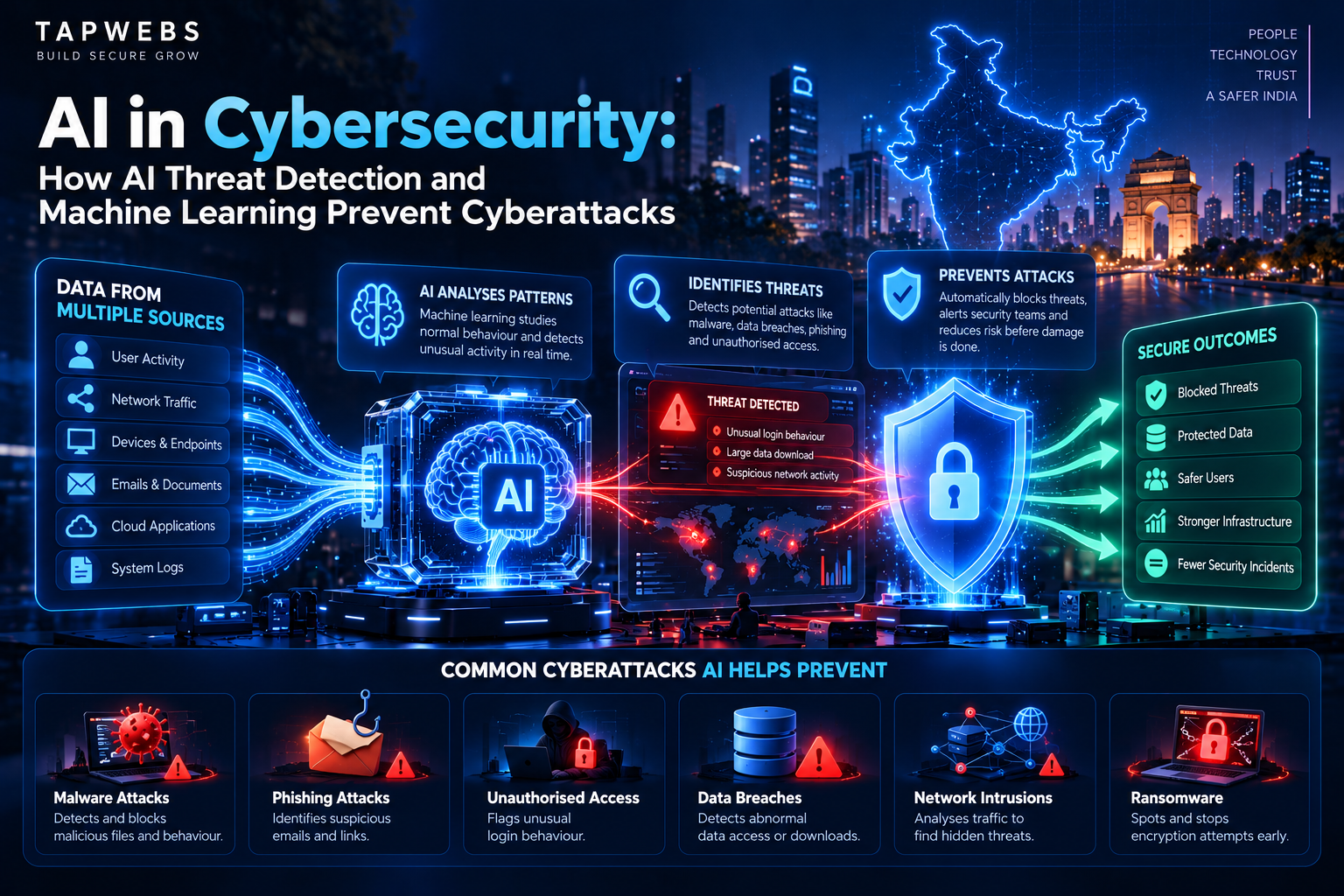
AI in Cybersecurity is changing how organizations monitor their digital systems, protect sensitive information, and respond to potential threats. Businesses rely on technology for everything from processing online payments to storing customer records and managing remote teams. Each connected service creates potential security risks, especially when software is outdated, access permissions are too broad, or suspicious activity goes unnoticed. Traditional security tools, including firewalls and rule-based detection systems, remain important, but they may not identify every unfamiliar threat. By combining these tools with AI Threat Detection and Machine Learning, security teams can examine unusual activity, recognize potential warning signs, and investigate risks more efficiently.
Modern cyberattacks can involve automated vulnerability scanning, stolen login credentials, phishing messages, and attempts to move between compromised systems. A single exposed application or stolen account may provide an attacker with access to information that should remain private. AI-assisted security tools can analyze large volumes of system and network data to help identify suspicious patterns. For example, a security system might flag an account that suddenly accesses sensitive files it has never used before. The alert does not automatically prove an attack is taking place, but it gives security analysts a reason to investigate.
Protecting customer information is another important reason to invest in AI in Cybersecurity. A data breach can expose personal details, financial records, or authentication credentials, damaging customer trust and disrupting business operations. AI-assisted monitoring can help identify unusual login attempts, suspicious file activity, and unexpected data transfers. When combined with strong access controls, regular software updates, and clear security procedures, these capabilities can improve an organization's ability to manage risk. However, no security technology can guarantee complete protection. Effective cybersecurity depends on a combination of technology, people, and well-maintained processes.
Key Takeaways
- AI in Cybersecurity helps security teams analyze unusual activity and investigate potential threats across digital systems.
- AI Threat Detection can help identify suspicious behavior associated with phishing, malware, and some previously unknown threats, although detection is never guaranteed.
- Machine Learning analyzes patterns in security data and can help identify activity that differs from normal behavior.
- Behavioral analytics can support the detection of credential stuffing, unusual privilege use, and potential data theft.
- Combining automated monitoring with human oversight helps organizations respond to security incidents more effectively.
- Strong authentication, regular updates, protected backups, and access controls remain essential even when AI security tools are deployed.
AI in Cybersecurity: The Current Situation
AI in Cybersecurity is receiving greater attention as organizations adopt cloud platforms, connected applications, APIs, and remote-access systems. These technologies make business operations more flexible, but they also introduce additional services, accounts, and access points that need protection. Security teams must monitor activity across different environments instead of relying only on occasional checks or investigations after an incident. AI Threat Detection can analyze authentication records, network traffic, and endpoint activity to highlight patterns that deserve further investigation. When supported by Machine Learning, these tools can help identify changes in behavior that might indicate a security problem.
Consider a company that introduces a new cloud application. The application may be secure when it launches, but a later configuration change could accidentally expose sensitive information. Regular vulnerability assessments and automated configuration checks can help identify such problems. AI-assisted analysis may help prioritize findings by considering their context and potential risk. However, organizations should not assume that an AI system will discover every weakness. Manual reviews, patch management, penetration testing, and appropriate access restrictions remain important parts of a complete security strategy.
Major Cybersecurity Threats Facing Modern Systems
One of the biggest challenges in AI in Cybersecurity is dealing with attacks that can be launched and repeated automatically. Attackers scan publicly accessible systems for exposed services, outdated software, and weak administrative interfaces. Credential-stuffing attacks use previously stolen usernames and passwords to attempt access to other services, while password spraying tests a small number of common passwords against multiple accounts. If organizations fail to secure their systems, attackers may gain unauthorized access and attempt to reach additional resources. AI Threat Detection and Machine Learning can help identify unusual login patterns, suspicious network connections, and unexpected activity across devices. These systems can support an investigation, but they cannot guarantee that every attack will be identified.
Social engineering presents a different challenge because it targets people rather than relying entirely on technical weaknesses. Attackers may send convincing emails, impersonate managers, or use AI-generated voices to persuade employees to share confidential information or authorize fraudulent payments. An employee might also accidentally expose company information by entering it into an unapproved third-party AI service. These situations require more than automated monitoring. Organizations need clear data-handling policies, employee training, strong identity verification, and procedures for reporting suspicious requests.
| Threat Type | What Attackers Actually Do | Simple Practical Solution |
|---|---|---|
| Automated Vulnerability Scanners | Scripts scan networks and APIs for outdated software, exposed services, and configuration weaknesses. | Use automated vulnerability scanning, prioritize high-risk findings, and apply security updates promptly. |
| Generative Phishing & Deepfakes | Attackers create convincing messages, impersonate employees, or imitate executive voices to request confidential information or fraudulent payments. | Verify sensitive requests through a separate trusted channel, enforce strong authentication, and train employees to recognize impersonation attempts. |
| Unauthorized Data Exfiltration | Attackers or compromised accounts transfer sensitive business information outside authorized systems. | Apply data loss prevention controls, restrict access to sensitive information, and monitor unusual data transfers using AI Threat Detection where appropriate. |
| Credential Stuffing & Password Spraying | Automated scripts test stolen credentials or common passwords against multiple accounts. | Enforce multi-factor authentication, restrict repeated suspicious login attempts, and use risk-based access controls and Machine Learning to help identify abnormal activity. |
Practical Warning Signs to Watch For
- Unexplained increases in outbound data transfers that do not match normal business activity.
- Urgent emails, calls, or voice messages requesting payments or sensitive information while bypassing standard verification procedures.
- Login records showing unusual locations, unexpected access times, or impossible travel patterns.
- API keys, private keys, passwords, or configuration secrets exposed in public repositories or shared channels.
- Workstations or servers showing unusual CPU consumption or network activity without an identifiable business reason.
- Repeated account lockouts or authentication failures affecting multiple users.
- Unexpected changes to administrator permissions, identity settings, or security policies without an approved change request.
These warning signs should trigger an investigation rather than an automatic assumption that an attack has occurred. For example, a sudden increase in outbound traffic might result from a scheduled backup, a cloud migration, or unauthorized data transfer. Security teams should review the relevant logs, verify the user's activity, and look for additional evidence before deciding how to respond.
AI Threat Detection can help correlate related events, such as an unusual login followed by access to sensitive files. If the evidence indicates an active compromise, the organization may need to restrict the account or isolate the affected device. These actions should follow a documented incident-response procedure and take business impact into account.
Technical Foundations: Threat Detection and Analytics
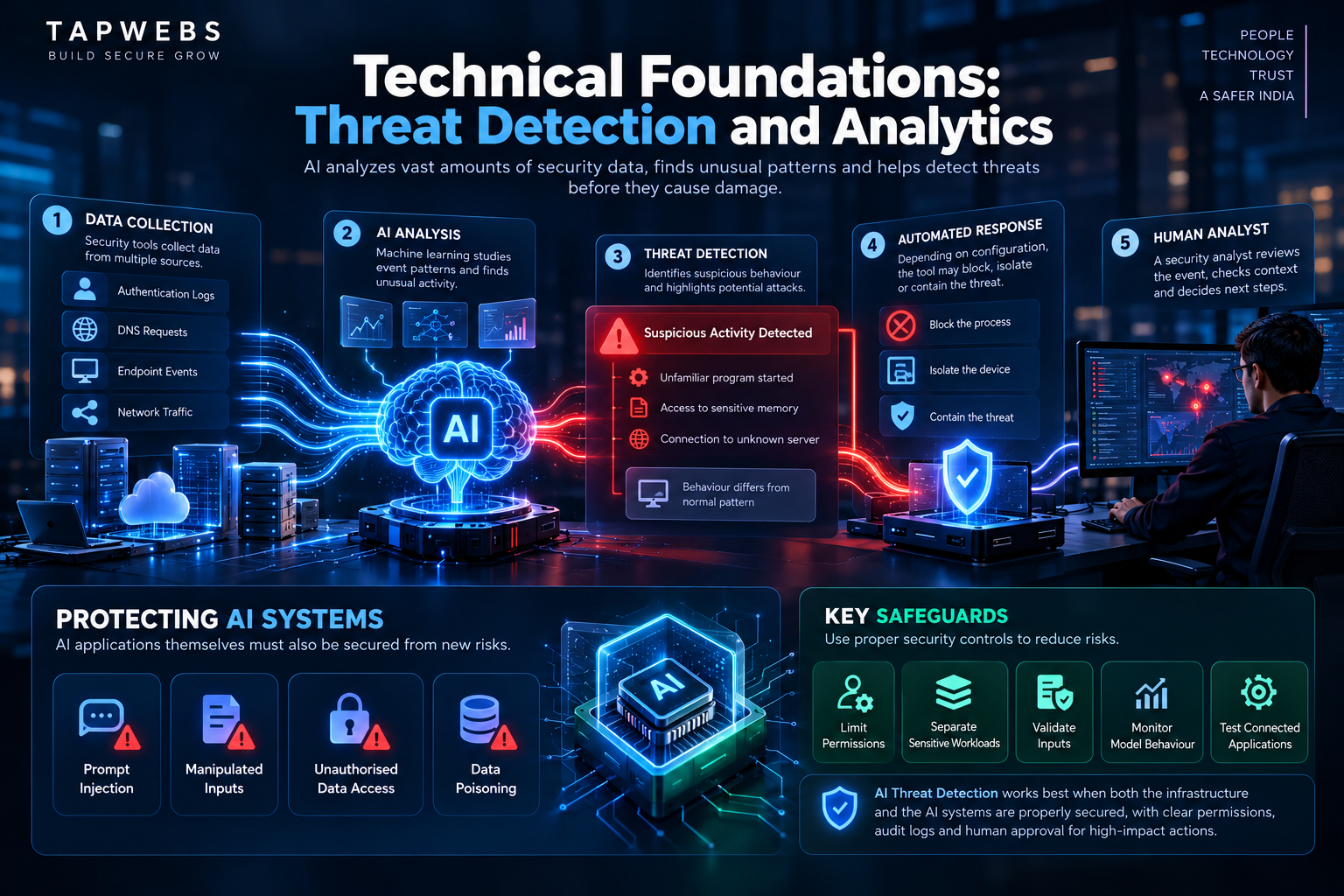
Understanding AI in Cybersecurity starts with how security tools collect and analyze information from users, applications, and devices. Organizations may generate authentication logs, DNS requests, endpoint events, and network traffic records throughout the day. Reviewing every event manually can be difficult, especially in large environments. AI Threat Detection can help identify relationships between events and highlight activity that differs from expected patterns.
Imagine an employee's computer that normally runs office applications and connects to a small number of approved services. One afternoon, an unfamiliar program starts a command-line process, attempts to access sensitive system memory, and connects to an unknown external server. An endpoint security tool may identify this combination as suspicious and create an alert. Depending on the tool's capabilities and configuration, it might also block the process or isolate the device. A security analyst would then examine the event history, determine whether the activity is legitimate, and decide whether further action is needed. This example illustrates how automated analysis can support an investigation without guaranteeing that every attack will be caught.
Organizations must also protect the AI systems they use for security and other business activities. AI applications may face prompt-injection attempts, manipulated inputs, unauthorized data access, and weaknesses in connected services. Some machine-learning systems can also be affected by data poisoning if attackers manage to influence their training data. Appropriate safeguards include limiting permissions, separating sensitive workloads, validating inputs, monitoring model behavior, and testing connected applications for security weaknesses.
The same principle applies when AI tools are used to investigate security incidents. A system should not automatically receive unrestricted access to sensitive information or permission to make every possible change. Carefully defined permissions, audit logs, testing, and human approval for high-impact actions can help reduce the risk of unintended consequences. Effective AI Threat Detection therefore requires attention to both conventional infrastructure and the systems supporting Machine Learning.
Machine Learning Architecture: Predictive Analytics and Classification
Machine Learning is one of the technologies used to support AI in Cybersecurity. Supervised learning models are trained using labeled examples, such as known malicious files and legitimate system activity. Depending on the model and available data, they may examine file characteristics, network behavior, or other signals to estimate whether an event is suspicious. These models can help identify established attack patterns and some previously unseen variations. However, their performance depends on the quality and relevance of their training data, and unfamiliar attacks may not match the patterns they have learned.
Unsupervised learning approaches offer another way to examine security data. Rather than relying on the same kind of labeled examples, these methods look for clusters, unusual patterns, or activity that differs from an observed baseline. For instance, an employee account that suddenly accesses unfamiliar databases or a device that begins communicating with unusual external services may be flagged for review. Such deviations can indicate suspicious activity, but they can also result from legitimate changes in responsibilities or system configuration.
Some security platforms combine different analytical techniques to improve detection. A model might flag an unusual login, while additional rules examine whether the account accessed sensitive information or attempted to change its permissions. Considering multiple signals can provide more context than treating an isolated event as proof of an attack. Even so, AI systems can produce false positives and false negatives. Effective AI Threat Detection therefore depends on appropriate configuration, regular evaluation, and investigation by people who understand the organization's systems.
The Operational Benefits of Automated Defense
One potential benefit of AI in Cybersecurity is helping organizations improve Mean Time to Detect (MTTD) and Mean Time to Respond (MTTR). MTTD measures how long it takes to identify a security incident, while MTTR generally measures the time required to respond or recover, depending on the organization's chosen definition. AI-assisted monitoring can help analysts recognize suspicious activity by correlating events across different systems. When connected to an approved response workflow, a security platform may also restrict a suspicious session or isolate an affected endpoint.
The actual benefit depends on the organization's environment and the quality of its implementation. A poorly configured tool may generate too many false alarms, while an overly aggressive automated response may interrupt legitimate business activity. Businesses should establish baseline measurements before deployment and compare results after the tool has been introduced. This provides a more reliable way to determine whether automation is improving security operations.
Illustrative example: Suppose a security team takes an average of 40 minutes to identify a particular type of suspicious account activity before introducing an AI-assisted monitoring tool. After deployment and testing, the average falls to 25 minutes. In this hypothetical example, detection time has improved by 15 minutes. The organization should also measure false-positive rates and investigate whether genuine incidents are being missed before concluding that the tool has improved overall security.
AI-assisted security can also help manage growing volumes of alerts. By grouping related events and summarizing relevant information, these tools may reduce repetitive review work and give analysts more time to investigate serious incidents. Machine Learning can support these processes, while access controls, audit logs, patch management, and tested recovery procedures provide the underlying protection.
Key Advantages for Business Leaders
- Helps security teams identify suspicious activity and investigate potential intrusions earlier.
- Supports the protection of customer information and business reputation through improved monitoring.
- Can reduce repetitive alert-review work by grouping related events and helping prioritize investigations.
- Helps security teams allocate resources by highlighting higher-risk activity and systems.
- Supports monitoring across cloud environments, endpoints, APIs, and remote-access systems.
- Makes it easier to investigate incidents when security logs and audit records are collected consistently.
- Can help identify unusual behavior associated with emerging threats, including some threats that lack established signatures.
- Provides measurable opportunities to evaluate detection time, response time, and the quality of security alerts.
Challenges and Limitations of Algorithmic Defense
Despite its advantages, AI in Cybersecurity has limitations that organizations need to understand before deploying it. Security models can produce false positives by flagging legitimate activity as suspicious. For example, an authorized administrator performing a large system update may generate behavior that differs from the normal baseline. False negatives are also possible when malicious activity resembles legitimate behavior or falls outside a model's detection capabilities. If automated controls block important business processes without sufficient validation, they may disrupt operations.
Organizations should test their AI Threat Detection systems using representative data and realistic scenarios. They should also review alert quality, investigate missed detections, and establish approval requirements for actions that could affect critical systems. A useful evaluation should consider more than the number of alerts generated. It should also examine how many alerts represent genuine risks, how quickly analysts can investigate them, and whether the system is missing important threats.
Attackers can also use automation and AI-assisted techniques to improve their own Cyberattacks. They may generate convincing phishing messages, automate reconnaissance, or modify malicious files in attempts to evade security controls. This makes layered protection important. Organizations should regularly assess their security tools, update detection rules and models when appropriate, conduct authorized security testing, and investigate new attack patterns.
Retraining a Machine Learning model does not automatically guarantee better protection. Changes need to be evaluated to ensure they improve detection without introducing unacceptable errors. Businesses should also consider privacy, operating costs, integration requirements, and the skills needed to manage these systems. AI should strengthen an existing security program rather than become the only line of defense.
Forward-Looking Trends: The Evolution of Defensive AI
One emerging development in AI in Cybersecurity is the use of AI agents to assist with security workflows. Depending on their design and permissions, these systems may gather relevant logs, summarize alerts, identify related events, and prepare incident reports for analysts. Some implementations may also carry out approved investigative tasks or recommend containment steps. These capabilities could help security teams manage routine work, but autonomous systems can make mistakes or act on incomplete information.
Organizations should restrict the permissions of AI agents to what they actually need. Their actions should be logged, tested, and reviewed, particularly when they interact with sensitive systems. High-impact actions, such as deleting data, disabling critical services, or changing important access policies, should have suitable safeguards and human approval where appropriate. The objective is to use automation responsibly without creating additional security risks.
Another important area is software supply-chain security. Modern applications often depend on open-source packages, external APIs, cloud services, and third-party components. A vulnerable or compromised dependency can introduce risks even when the main application has been developed carefully. Security teams can use automated code analysis, dependency scanning, secret detection, and runtime monitoring to identify potential problems during development and after deployment.
AI Threat Detection and Machine Learning may help prioritize suspicious findings, but they should complement established practices such as secure coding, software composition analysis, code review, and timely patching. Organizations should also maintain an inventory of important dependencies and establish a process for responding when a vulnerability is discovered in a component they use.
Post-Incident Containment and Recovery Roadmap
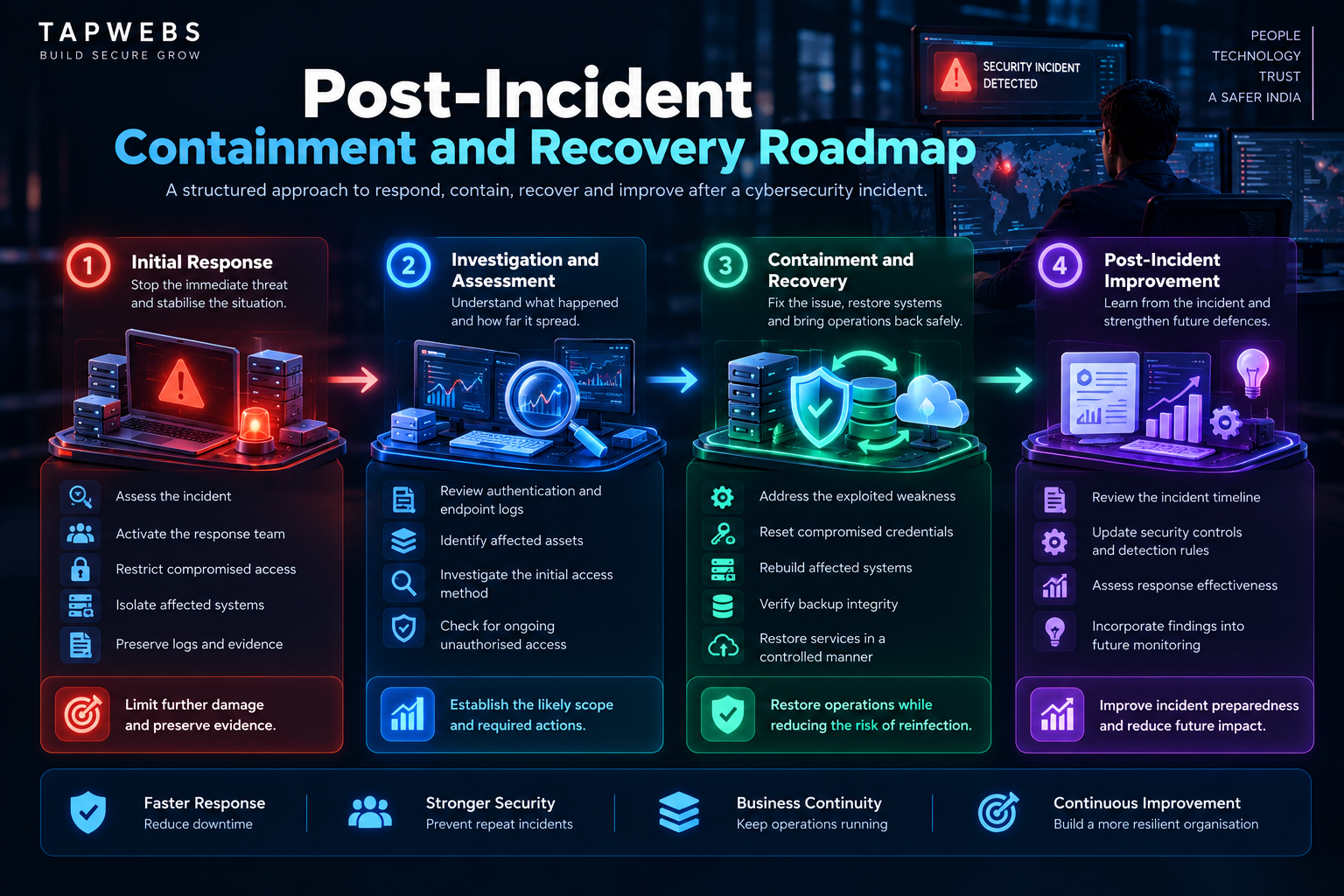
The following timeline is an example of how an organization might organize its response to a cybersecurity incident. The actual sequence and timing should depend on the severity of the incident, the affected systems, business requirements, and applicable reporting obligations.
| Timeframe | Recommended Operational Actions | Strategic Outcome |
|---|---|---|
| Initial Response | Assess the incident, activate the response team, restrict confirmed compromised access, isolate affected systems when appropriate, and preserve relevant logs and evidence. | Limit further damage and preserve information needed for investigation. |
| Investigation and Assessment | Review authentication and endpoint logs, identify affected assets, investigate the initial access method, and determine whether unauthorized access is continuing. | Establish the likely scope of the incident and identify the actions required for containment. |
| Containment and Recovery | Address the exploited weakness, reset compromised credentials, rebuild affected systems when necessary, verify backup integrity, and restore services in a controlled manner. | Restore operations while reducing the risk of reinfection or continued unauthorized access. |
| Post-Incident Improvement | Review the incident timeline, update security controls and detection rules, assess response effectiveness, and incorporate findings into future monitoring. | Improve incident preparedness and reduce the likelihood or impact of similar incidents. |
Practical Implementation: Building an Algorithmic Defense Strategy
Building a practical AI in Cybersecurity strategy starts with understanding the organization's risks rather than purchasing technology simply because it uses AI. Businesses should identify their most valuable data, critical applications, exposed services, and common security weaknesses. They can then determine where AI-assisted monitoring may provide the greatest benefit, such as detecting suspicious account activity, prioritizing vulnerability findings, or identifying unusual API behavior.
Before selecting a tool, organizations should define the problem they want to solve and establish a baseline for measuring progress. When evaluating Machine Learning tools, they should consider detection accuracy, false-positive rates, data requirements, integration with existing systems, privacy protections, operating costs, and the level of human oversight required. A small pilot focused on a specific security problem can help determine whether the tool provides enough value to justify a wider deployment.
Strong foundational controls remain essential regardless of the tools selected. Organizations should secure administrative accounts, apply updates promptly, restrict unnecessary permissions, protect credentials, and maintain tested backups. Developers should avoid storing secrets in source code and use appropriate secure storage mechanisms for sensitive credentials. Businesses should also establish procedures for investigating alerts and responding to confirmed incidents.
After deployment, security teams should review performance on a regular schedule. Useful measurements include detection time, response time, the proportion of alerts that turn out to be genuine threats, and the number of missed detections found during testing. If a tool generates too many false alarms or disrupts legitimate work, its configuration may need to be adjusted. Combining these practices with well-tested AI Threat Detection can help organizations build a more reliable security program without depending on automation alone.
Essential Security Checklist for Engineering Teams
- Keep API tokens, private keys, certificates, and cloud credentials out of public code repositories.
- Enforce multi-factor authentication, preferably phishing-resistant methods, for email, identity providers, and administrative access.
- Restrict unnecessary outbound network connections and limit access to sensitive development and production environments.
- Integrate automated secret scanning and vulnerability checks into software development and deployment workflows.
- Collect and protect relevant system logs, and define who is responsible for reviewing security alerts and investigating suspicious activity.
- Evaluate Machine Learning models using representative security data and authorized attack simulations before relying on their outputs.
- Conduct regular, role-specific employee training to help staff recognize phishing, impersonation, and other social engineering attempts.
- Review and tune AI Threat Detection alerts on a defined schedule to reduce false positives while maintaining visibility into potential threats.
- Maintain secure backups and test restoration procedures regularly according to business recovery requirements.
- Review privileged accounts and access permissions at scheduled intervals, removing accounts and privileges that are no longer required.
- Document incident-response responsibilities and test the response plan through periodic exercises.
- Record the detection and response metrics needed to evaluate whether security tools are improving performance.
Frequently Asked Questions (FAQs)
What is AI in cybersecurity?
AI in Cybersecurity refers to the use of artificial intelligence techniques to help protect digital systems, networks, applications, and data. These tools can analyze security events, identify suspicious patterns, and assist with alert investigation. Their effectiveness depends on the data they receive, how they are configured, and the security controls used alongside them.
How does AI threat detection work?
AI Threat Detection analyzes information such as login activity, network connections, email signals, and endpoint behavior to identify patterns associated with potential threats. It may compare current activity with known attack indicators or typical behavior. When suspicious activity is detected, the system can alert security analysts or trigger predefined actions if it has been configured to do so. Alerts still need appropriate investigation because legitimate activity can sometimes appear unusual.
How does machine learning prevent cyberattacks?
Machine Learning can help prevent some Cyberattacks by identifying suspicious activity and supporting security controls that block or restrict risky actions. Supervised models learn from labeled examples, while unsupervised approaches look for unusual patterns in data. These techniques can improve detection, but they cannot identify every attack or guarantee that a breach will be prevented. They work best alongside measures such as multi-factor authentication, patch management, access controls, and incident response.
Can AI detect phishing and malware?
Yes, AI-based security tools can help identify phishing messages and malicious files by analyzing characteristics such as email content, suspicious links, file behavior, and unusual activity. Some systems can also examine files in isolated environments to look for potentially harmful behavior. However, sophisticated phishing attempts and new malware variants may evade detection. Organizations should combine these tools with strong authentication, email security controls, regular updates, and employee awareness training.
Conclusion
AI in Cybersecurity can help organizations manage the growing volume and complexity of digital threats. By analyzing activity across endpoints, networks, accounts, and applications, AI-assisted tools can help identify suspicious behavior and give security teams more information for investigation. Effective AI Threat Detection, supported by Machine Learning, can improve alert prioritization and help organizations respond to certain threats more efficiently. However, these capabilities depend on reliable data, appropriate configuration, and integration with established security practices.
The value of AI should be measured through real operational results rather than assumptions about what a tool can do. Organizations should evaluate detection quality, monitor false positives, test their response procedures, and review whether automation is helping security teams work more effectively. Strong access controls, secure development practices, employee awareness, and reliable recovery plans remain essential.
Ultimately, AI is most valuable when it supports experienced security professionals rather than replacing human judgment. Combining intelligent monitoring with established cybersecurity controls gives businesses a more practical foundation for managing Cyberattacks, protecting sensitive information, and responding to new risks as their digital environments evolve.