Generative Engine Optimization (GEO) Strategies: How to Improve Visibility on ChatGPT, Perplexity & Google AI
Discover how Generative Engine Optimization (GEO) can improve your website's visibility across ChatGPT, Perplexity, and Google AI. Explore proven GEO strategies, AI search optimization, content optimization, and technical SEO practices to help your business get discovered in AI-generated answers and reach more potential customers.
Overview
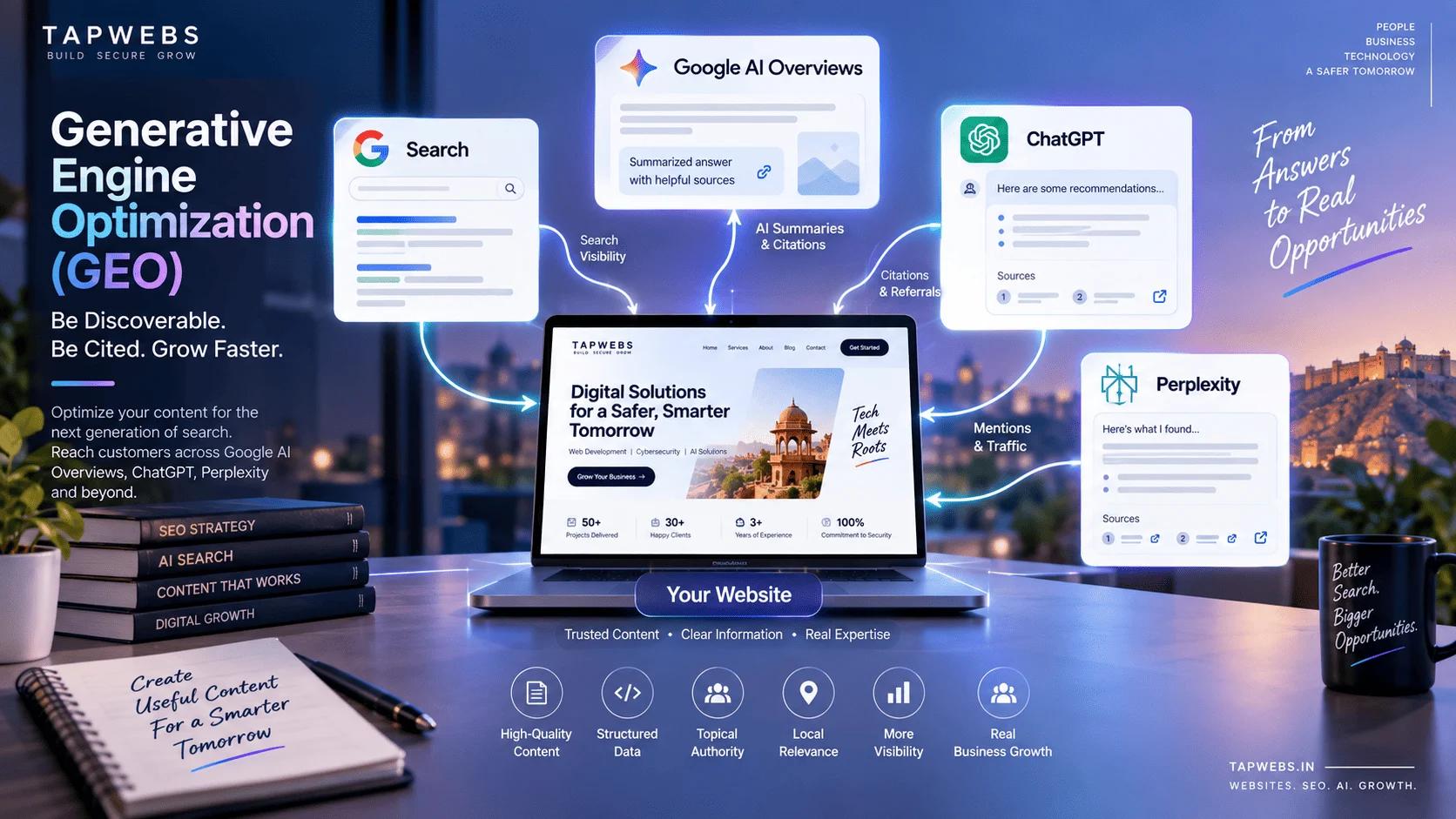
Generative Engine Optimization (GEO) is becoming increasingly important as the way people search for information online continues to change. Instead of opening several websites and comparing information themselves, users are increasingly asking AI platforms such as ChatGPT, Perplexity and Google AI to provide answers directly. These platforms can bring together information from different online sources and present it in a single response. This shift has made GEO an important consideration for businesses that want their websites and content to reach the right audience.
Generative Engine Optimization (GEO) takes traditional SEO a step further by focusing on how content can be discovered, understood and potentially referenced by AI-powered platforms. Traditional SEO has mainly focused on helping websites appear in search engine results when users search for particular keywords. If the article provides clear answers, practical examples and reliable information. The same principle applies to businesses trying to become more visible through Google AI experiences.
Generative Engine Optimization (GEO) is not simply about getting mentioned by an AI platform; it is also about making online information useful enough to support customer decisions. A well-maintained website, accurate business details, informative articles and a consistent online presence can all contribute to stronger digital visibility. ChatGPT, Perplexity and Google AI each have their own ways of finding and presenting information, so there is no guaranteed method of appearing in every response.
Key Takeaways
- Generative Engine Optimization (GEO) helps businesses improve the chances of their content being discovered and used in AI-generated answers.
- ChatGPT, Perplexity and Google AI are changing how people research products, compare services and find information online.
- Clear, accurate and genuinely useful content can make a website more relevant to AI-powered search experiences.
- Strong SEO, topical authority, original research and a credible online presence support an effective GEO strategy.
- Businesses should create content around real customer questions instead of repeating keywords to influence AI platforms.
- GEO complements traditional SEO and Answer Engine Optimization (AEO); it does not replace them.
- Regularly reviewing website performance and AI search visibility helps businesses understand where their digital presence can improve.
What Is Generative Engine Optimization (GEO)?
Generative Engine Optimization (GEO) is the process of improving online content so that AI-powered search platforms can discover, understand and potentially use it when generating answers. These platforms do more than display a list of website links. They can retrieve information from different sources, understand the context of a question and prepare a response that brings relevant information together. GEO focuses on making website content clear, accurate, relevant and useful enough to be considered during this process.
To understand the idea, imagine someone asking an AI platform, "What should a small business look for when choosing an accounting software?" The platform may discuss pricing, reporting features, ease of use and available integrations. A company that has published a detailed and helpful guide covering these topics may have information relevant to that question. However, simply publishing an article does not guarantee that an AI platform will select it. The content must be accessible and relevant to the question, and the platform must be able to retrieve it.
Generative Engine Optimization involves improving several aspects of a website, including content quality, information structure, technical accessibility and brand credibility. Businesses need to make their information easy to understand and maintain accurate details across their online presence. The objective is not to write exclusively for AI systems. It is to create content that genuinely helps people while making it easier for search and AI systems to interpret that information.
How AI Search Engines Are Changing Online Search
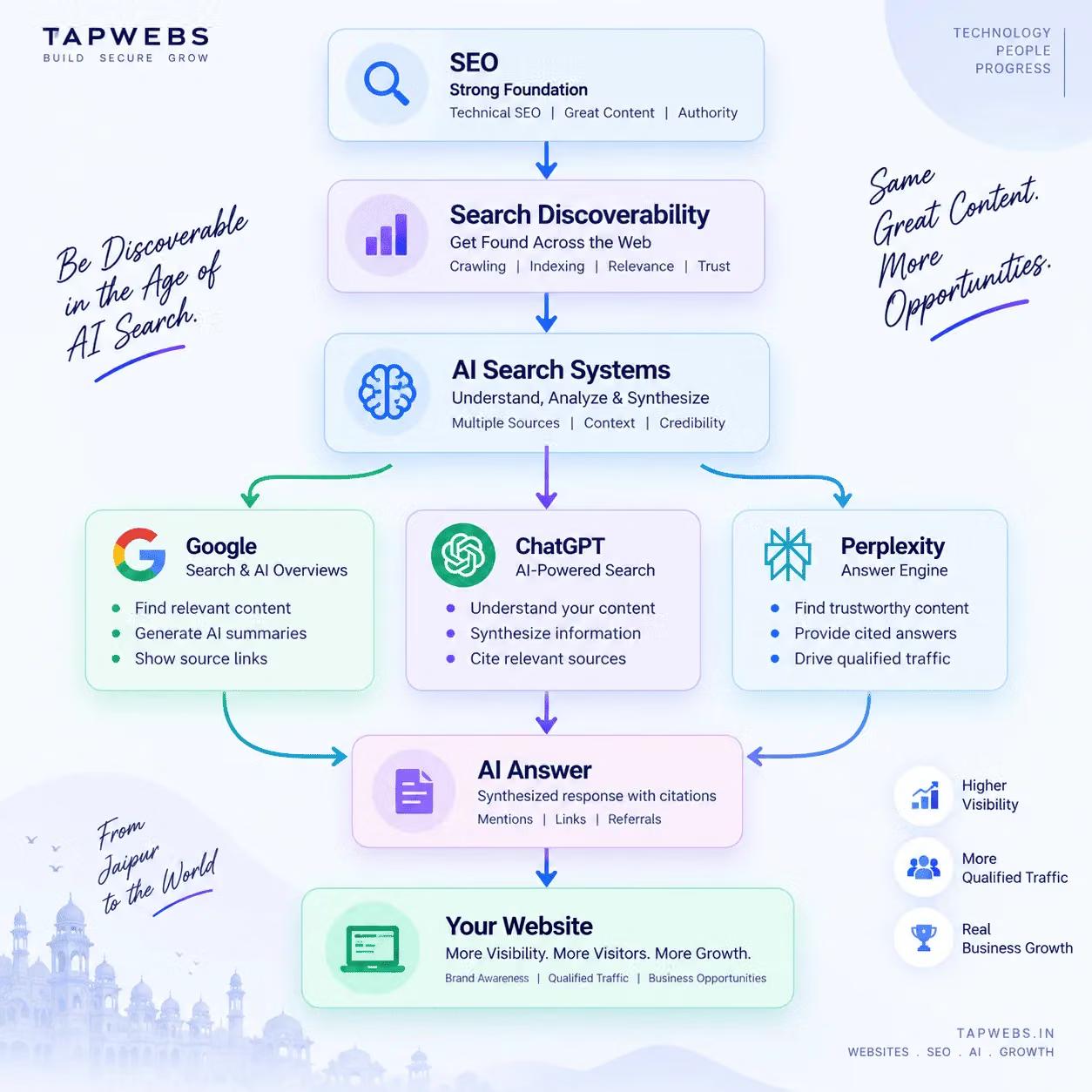
Online search used to begin with a few keywords and a list of websites. Someone looking for a website development company might search for "best website developers near me", open several results and compare their services manually. Today, that person can ask ChatGPT or Perplexity a much more detailed question, such as "What should I consider before hiring a website development agency for my restaurant?" The answer may cover website features, pricing, mobile responsiveness and online ordering options without requiring the user to visit multiple websites first.
Another noticeable change is the way information is presented. Traditional search results generally direct users towards individual webpages, whereas AI-powered platforms can combine information from several sources into a conversational response. Some platforms also provide links or references so users can check the original information. This changes the way businesses need to approach online visibility. Ranking for a keyword remains useful, but companies should also consider whether their website provides the kind of detailed answers people are looking for.
| Traditional Search | AI-Powered Search |
|---|---|
| Displays a list of website links related to a query. | Provides conversational answers using information from relevant sources. |
| Users usually open different websites to compare information. | Users can receive a combined explanation in one response. |
| Searches often begin with short keywords. | Searches can include detailed questions and follow-up prompts. |
| Website rankings play an important role in visibility. | Content relevance, source quality and information retrieval can influence visibility. |
| Users usually evaluate different sources themselves. | AI platforms may summarise information from multiple sources. |
For businesses, this shift creates additional opportunities to reach potential customers. Someone researching a service may discover a company through an AI-generated response before visiting its website. Detailed customer questions also give businesses more opportunities to explain their products, services and expertise through useful content. Companies that continue focusing only on traditional keyword rankings may miss some of these changing discovery opportunities.
GEO vs SEO vs AEO: Understanding the Differences
Generative Engine Optimization, Search Engine Optimization and Answer Engine Optimization are closely related, but each has a different primary focus. SEO aims to improve a website's visibility in traditional search engine results. AEO focuses on making information suitable for direct answers, featured snippets and question-based search experiences. GEO focuses on improving the chances of content being discovered, understood and potentially used by generative AI platforms.
Consider a company that provides website development services. Its SEO strategy might focus on keywords such as "website development company" and "business website design". Its AEO strategy might answer questions such as "How much does a business website cost?" Its GEO strategy would focus on publishing useful, detailed information that could be relevant when users ask AI platforms for website development advice. These approaches are different, but they can support the same overall goal: making the business easier to discover online.
| Factor | SEO | AEO | GEO |
|---|---|---|---|
| Full Form | Search Engine Optimization | Answer Engine Optimization | Generative Engine Optimization |
| Main Focus | Improving visibility in search engine results. | Providing direct answers to user questions. | Improving visibility in generative AI responses. |
| Platforms | Google, Bing and other search engines. | Featured snippets, voice assistants and answer-based search. | ChatGPT, Perplexity and Google AI experiences. |
| Content Approach | Relevant, keyword-focused and useful website content. | Clear, direct and question-based answers. | Contextual, credible and well-organised information. |
| Main Objective | Increase organic search visibility. | Make information easier to use in direct answers. | Improve the chances of being discovered or referenced by AI platforms. |
Businesses do not need to choose one approach and ignore the others. Strong keyword research, useful content, clear answers and a technically sound website can support all three. For example, an article that ranks for a relevant search query, answers customer questions and includes original information can serve both traditional search visitors and people discovering information through AI platforms. Combining SEO, AEO and GEO creates a more complete approach to digital visibility.
How ChatGPT, Perplexity and Google AI Discover Content
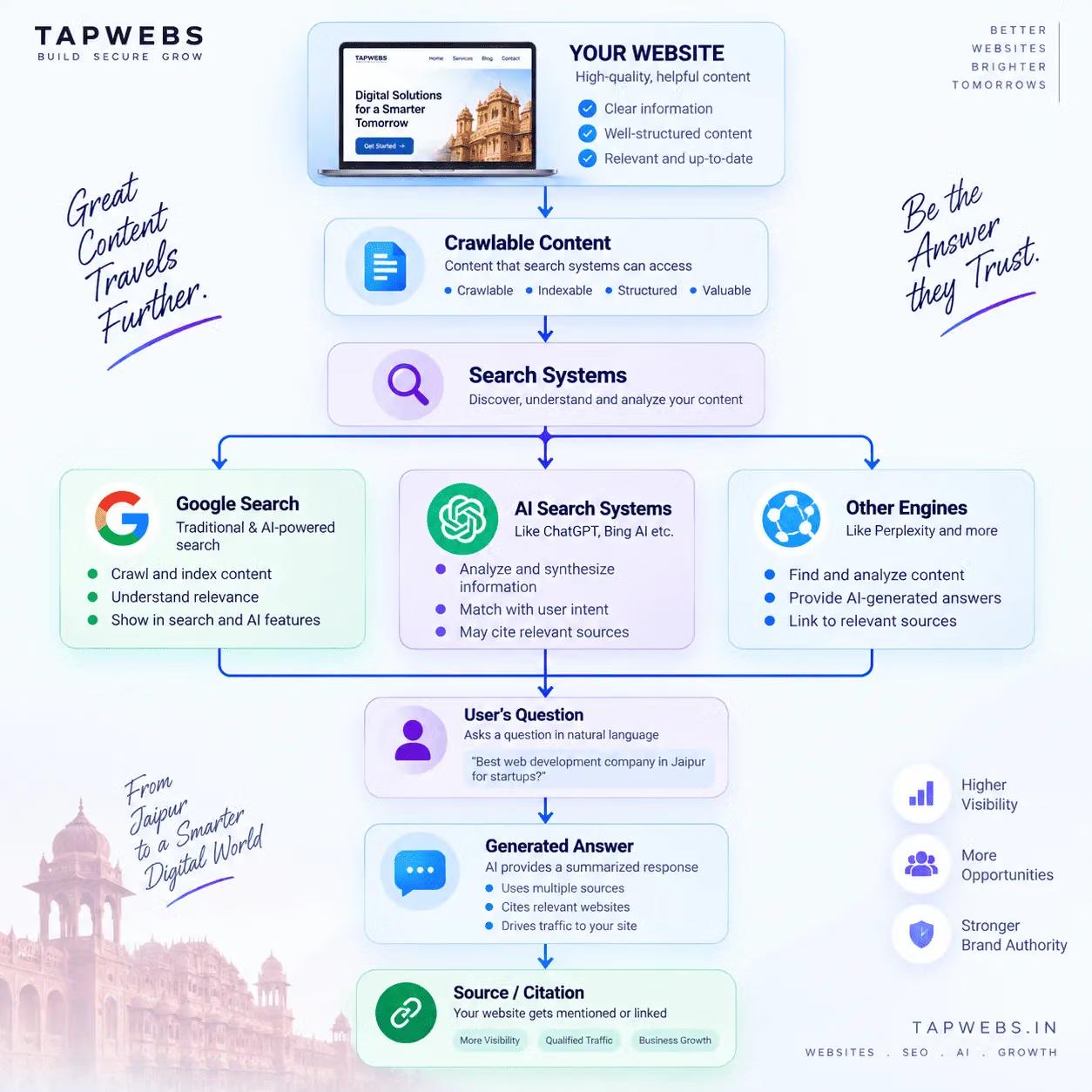
ChatGPT, Perplexity and Google AI do not all discover and present website information in exactly the same way. Each platform has its own search capabilities, retrieval systems and methods of generating responses. Some answers may involve live web search, while others may use information available through different retrieval systems. This is why businesses should understand the basic discovery process rather than assume that publishing an article automatically makes it visible across every AI platform.
ChatGPT can use web search to retrieve relevant information from online sources when answering certain questions. OpenAI identifies different crawlers for different purposes, including OAI-SearchBot for search-related discovery and GPTBot for other data collection purposes. Website owners should understand these distinctions when reviewing their crawling permissions. Allowing a crawler does not guarantee that a webpage will be included in an answer, but blocking relevant access may create an avoidable discovery barrier.
Perplexity searches online sources and presents answers with supporting references. Its PerplexityBot crawler is used for search-related discovery. Businesses can review their robots.txt configuration to understand whether their website permits access to this crawler. Useful explanations, relevant research and well-supported information can make a webpage more valuable to readers and potentially relevant to Perplexity's search process.
Google AI experiences, including AI Overviews, are connected to Google's search ecosystem. Google uses its existing search infrastructure and related technologies to identify information for AI-generated responses. Website owners should continue following Google's Search guidelines and technical requirements. There is no separate guaranteed method for appearing in an AI Overview, and following SEO best practices does not automatically mean a page will be selected.
| Platform | Discovery Approach | What Businesses Should Focus On |
|---|---|---|
| ChatGPT | Can use web search and relevant search-related retrieval systems. | Allow appropriate search crawler access and publish useful, accurate information. |
| Perplexity | Searches online sources and provides supporting references. | Maintain accessible content, clear explanations and credible information. |
| Google AI | Uses Google's search infrastructure and relevant information retrieval systems. | Follow Google Search guidelines and maintain strong technical SEO. |
Key GEO Strategies to Improve AI Search Visibility
Improving AI search visibility starts with understanding what potential customers actually want to know. Businesses should not publish articles simply to include more keywords or increase the number of pages on their websites. Instead, they should explain topics properly, answer common questions and provide information that helps readers make decisions. An article explaining how a service works, what problems it solves and what customers should consider before purchasing is generally more useful than a page filled with repeated promotional statements.
Another important part of Generative Engine Optimization is developing a clear area of expertise. A website that consistently publishes useful information about related subjects can provide visitors with a more complete understanding of a topic. For example, a digital marketing agency might cover keyword research, technical SEO, content marketing, website optimisation and analytics through connected articles. This helps readers explore related subjects while giving search systems more context about the website.
Content structure also deserves attention. Long articles should be divided into meaningful sections, with descriptive headings and focused paragraphs. Lists can make instructions easier to follow, while tables can help readers compare products, features or processes. Businesses should also include original information wherever possible, such as survey results, case studies, practical observations and relevant research. Important claims should be supported by reliable sources rather than presented without evidence.
How to Optimize Your Website for ChatGPT
Improving website visibility on ChatGPT begins with making sure that the information on your website is useful, accessible and relevant to the questions your customers ask. When ChatGPT uses web search, it may retrieve information from online pages and include source links in its responses. Businesses should therefore publish detailed articles, clear service descriptions and practical guides that explain their expertise. Pages that only promote a business without answering customer questions may provide limited value to someone researching a particular topic.
Website owners should also review their robots.txt settings to understand whether OAI-SearchBot is allowed to access relevant content. It is important not to confuse OAI-SearchBot with GPTBot because they have different stated purposes. Allowing search-related crawler access does not guarantee that ChatGPT will mention a business, but it can help avoid unintentionally restricting discovery through supported search features.
The quality of the information matters just as much as accessibility. A website development company, for example, can explain its services, development process, pricing factors and the features available to different types of businesses. It can also publish guides answering common questions about website maintenance, hosting and mobile-friendly design. These pages provide useful information for visitors rather than simply repeating sales messages.
| Content Type | Example Topic | Purpose |
|---|---|---|
| Educational Articles | What is technical SEO and why does it matter? | Explain a topic in detail. |
| Comparison Articles | Custom Website vs Website Builder | Help users compare available options. |
| Practical Guides | How to improve website loading speed | Provide useful instructions. |
| FAQs | How much does website development cost? | Answer common customer questions. |
| Case Studies | How a local business improved its online presence | Demonstrate practical experience. |
Businesses should also keep important information updated and review their website regularly. Outdated pricing, incorrect service details and broken pages can create a poor experience for visitors. Adding relevant examples, reliable references and clear explanations can improve the usefulness of the website. The objective is to build a resource that answers customer questions properly, not to force a particular mention in ChatGPT responses.
How to Improve Visibility on Perplexity AI
Perplexity is designed to answer questions by searching online information and presenting responses with supporting references. This gives businesses an opportunity to make their knowledge discoverable through useful articles, guides, research and comparisons. When someone asks about a product or service, information from relevant webpages may help the platform prepare its response. Businesses should therefore focus on publishing content that explains subjects clearly and provides enough evidence to support important claims.
Technical accessibility is also worth reviewing. Perplexity identifies PerplexityBot as its crawler for search-related discovery, so website owners can check whether their robots.txt settings allow access where appropriate. However, allowing the crawler does not guarantee that a webpage will appear in an answer. The user's question, the relevance of the content and the information available from other sources can all influence what Perplexity presents.
Original research and supporting references can also improve the usefulness of an article. Businesses can publish survey findings, practical case studies, industry observations and detailed guides based on their experience. Information that may change, such as pricing, product features and statistics, should be reviewed regularly. A consistent online presence and accurate business information can further support a company's credibility within its industry.
How to Optimize Content for Google AI Overviews
Google AI Overviews provide AI-generated summaries within certain Google Search experiences. They help users understand a topic by bringing together information from relevant web sources. For businesses, this makes it important to maintain useful website content and follow Google's existing search guidelines. Google has not introduced a separate guaranteed ranking method for AI Overviews. Website owners should continue focusing on helpful, reliable and people-first content instead of trying to find shortcuts to appear in AI-generated summaries.
A good starting point is to understand the questions customers ask and address them clearly within relevant website pages. For example, a company offering digital marketing services could explain how SEO works, what factors influence website rankings and how businesses can evaluate campaign performance. Each section should provide meaningful information rather than repeat the same keywords. Clear explanations, relevant examples and reliable supporting information can make an article more useful to visitors.
Google Search Console can help businesses review website impressions, clicks, indexing information and search queries. These insights can show which topics are attracting visitors and where content improvements may be useful. However, Search Console should not be treated as a complete report of AI Overview visibility. Businesses should continue improving their overall search presence instead of depending on guaranteed inclusion in a particular AI feature.
Best GEO Tools for AI Search Optimization
Businesses can use a combination of SEO and AI visibility tools to understand how their websites perform and where their content needs improvement. Some tools focus on traditional search performance, competitor research and backlinks, while others help monitor brand mentions across AI-powered platforms. Using the right combination can make it easier to identify content opportunities, evaluate competitors and understand how users are discovering a business.
However, no tool can guarantee that a website will appear in ChatGPT, Perplexity or Google AI responses. These platforms can generate different answers depending on the question, location and available information. GEO tools should therefore support content planning and performance analysis rather than replace useful writing, technical improvements and genuine industry knowledge.
| Tool | Main Purpose | How It Helps |
|---|---|---|
| Google Search Console | Website search performance | Monitors search impressions, clicks, indexing and search queries. |
| Semrush | SEO and competitor research | Supports keyword research, competitor analysis and content planning. |
| Ahrefs | Backlink and website analysis | Helps evaluate backlinks, competing websites and content opportunities. |
| Google Analytics 4 (GA4) | Website traffic analysis | Helps understand website visitors and their engagement. |
| Profound | AI search visibility monitoring | Helps businesses analyse brand visibility across supported AI platforms. |
| Otterly.AI | AI search monitoring | Tracks brand mentions and visibility across supported AI search platforms. |
Before selecting a tool, businesses should consider which platforms it supports, how frequently it updates its reports, what information it measures and whether the subscription fits their budget. They should also understand the limitations of AI visibility tracking. Since responses can vary between queries and platforms, reports should be used to identify broader patterns rather than treated as a guarantee of future performance.
Common GEO Mistakes Businesses Should Avoid
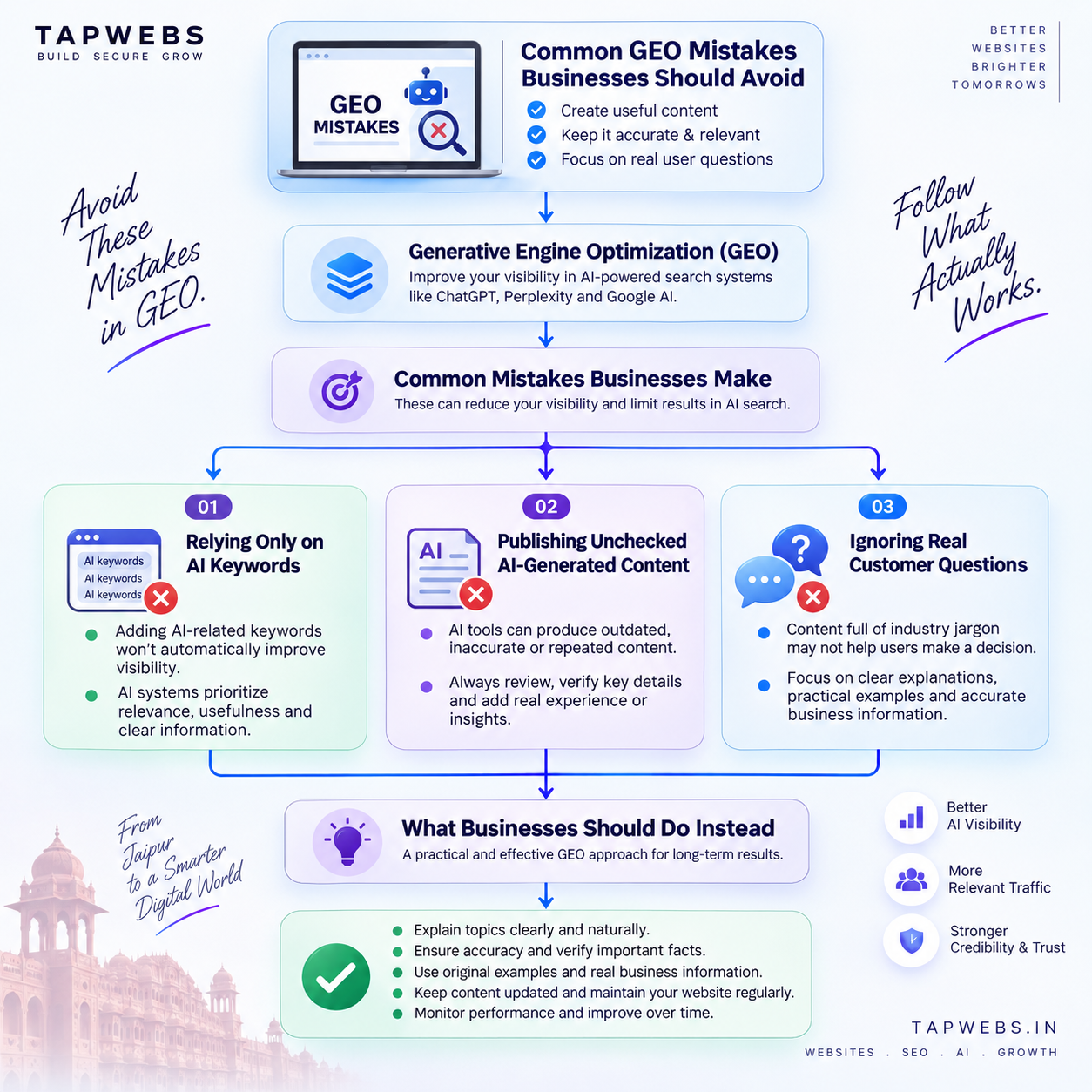
One common mistake in Generative Engine Optimization is assuming that adding AI-related keywords to an article will automatically improve its visibility. ChatGPT, Perplexity and Google AI do not simply select pages because they contain repeated phrases. Content needs to be relevant to the user's question and provide information that is useful and understandable. Businesses should focus on explaining topics properly instead of filling articles with keywords that make the writing sound unnatural.
Another mistake is publishing large amounts of AI-generated content without checking its accuracy or usefulness. AI writing tools can help with research and content development, but their output may contain outdated information, unsupported claims or repeated explanations. Businesses should review every article, verify important details and add relevant experience wherever possible. Publishing more pages does not automatically create a stronger online presence if those pages offer little value to readers.
| Common Mistake | Why It Creates a Problem | Practical Solution |
|---|---|---|
| Publishing Low-Quality AI Content | Content may be repetitive, inaccurate or lack useful information. | Review, fact-check and improve every article before publishing. |
| Ignoring Traditional SEO | Technical and indexing problems can limit website discovery. | Maintain strong technical SEO and follow search engine guidelines. |
| Keyword Stuffing | Repeated keywords make content difficult to read and reduce its usefulness. | Use relevant keywords naturally within meaningful explanations. |
| Publishing Unsupported Claims | Unverified statements can reduce content credibility. | Use reliable sources and provide evidence for important claims. |
| Ignoring Brand Presence | A website alone may not communicate the full credibility of a business. | Maintain accurate business information across relevant platforms. |
Businesses should also avoid ignoring the questions their customers actually ask. Content that focuses entirely on industry terminology may not help someone who is trying to make a practical decision. A useful GEO strategy should include clear explanations, original examples, accurate business information and regular website maintenance. Companies should review important facts and references, keep their content updated and monitor performance rather than expecting immediate results from every change.
Future of Generative Engine Optimization
The future of Generative Engine Optimization will depend largely on how people continue to use AI platforms for research, comparison and everyday decisions. Search queries are becoming more conversational, and users increasingly expect answers that address several parts of a question at once. Someone looking for accounting software, for example, may want to compare pricing, features, integrations and suitability for a small business in a single conversation. This creates an opportunity for businesses to publish more detailed content that explains their products and services in a practical way.
Brand credibility and original information are also likely to remain important. Businesses that publish useful research, share real experiences and maintain accurate information can provide more value than websites filled with general explanations. Case studies, surveys, industry reports and practical examples can help a company demonstrate its knowledge. At the same time, businesses should not depend on one AI platform because the systems used to retrieve and present information can change.
Another development is the growing connection between SEO and GEO. Traditional search engine optimisation will continue to support website discovery, indexing and organic visibility, while GEO encourages businesses to consider how their content may be used in AI-generated responses. Specialised tools may also become more common for monitoring brand mentions and AI search visibility. However, businesses will still need to interpret these reports carefully because AI answers can change depending on the question, platform and time of search.
Frequently Asked Questions (FAQs)
What is Generative Engine Optimization (GEO)?
Generative Engine Optimization (GEO) is the process of improving website content so that AI-powered platforms can discover, understand and potentially use it when generating answers. It focuses on content quality, relevance, clear structure and credibility. Businesses use GEO to improve their opportunities for visibility across platforms such as ChatGPT, Perplexity and Google AI.
How is GEO different from traditional SEO?
Traditional SEO focuses on improving a website's visibility in search engine results, while GEO focuses on making content relevant and understandable for generative AI platforms. SEO commonly involves keyword research, technical optimisation and backlinks. GEO places additional attention on clear explanations, contextual information and content that may be useful in AI-generated answers. Both approaches can work together.
How can I make my website visible on ChatGPT?
Start by publishing helpful and accurate content that answers questions related to your industry. Review your website's robots.txt settings and check whether OAI-SearchBot is allowed if you want your content to be discoverable through ChatGPT search. Maintain clear service pages, useful articles and a technically accessible website. However, allowing crawler access does not guarantee that ChatGPT will mention your business.
How can I improve my website's visibility on Perplexity AI?
Create detailed and reliable content that answers specific user questions. Include relevant examples, original information and supporting references where appropriate. You should also review your robots.txt file to understand whether PerplexityBot can access your website. Content relevance and source quality remain important, and there is no guaranteed method for getting referenced by Perplexity.
How can I appear in Google AI Overviews?
Follow Google's existing Search guidelines and publish helpful, reliable content that answers relevant questions. Maintain good technical SEO, use descriptive headings, improve website usability and implement appropriate structured data where applicable. Google does not provide a separate guaranteed method for appearing in AI Overviews, so businesses should continue focusing on overall search quality.
Does GEO replace SEO?
No. GEO does not replace traditional SEO. Search engine optimisation remains important for website discovery, indexing and organic visibility. GEO builds on these foundations by considering how generative AI platforms retrieve and present information. Businesses should combine both approaches to develop a stronger online presence.
Which tools are useful for Generative Engine Optimization?
Google Search Console, Semrush, Ahrefs and Google Analytics 4 can support website research and performance monitoring. Specialised tools such as Profound and Otterly.AI can help businesses monitor brand visibility across supported AI platforms. The right tools depend on business requirements, budget and the type of information a company wants to track.
How long does it take to see results from GEO?
There is no fixed timeline for GEO results. Visibility depends on factors such as website accessibility, content quality, topic relevance, platform retrieval systems and the questions users ask. Businesses should focus on consistent content improvements and monitor their visibility over time instead of expecting immediate mentions in AI-generated answers.
Conclusion
Generative Engine Optimization is becoming an important consideration for businesses as people increasingly use AI-powered platforms to discover information, compare services and make decisions. ChatGPT, Perplexity and Google AI have introduced new ways for users to find answers, creating additional opportunities for businesses to make their knowledge and services visible. Publishing useful articles, answering customer questions, maintaining a well-organised website and building a credible online presence can all support this effort. GEO does not guarantee that a business will appear in an AI-generated answer, but it encourages companies to improve the quality and usefulness of their online information.
In the end, Generative Engine Optimization works best when businesses focus on helping people rather than trying to manipulate AI platforms. Companies should continue investing in traditional SEO while improving content quality, sharing original information, maintaining technical accessibility and understanding how customers search for solutions. The online search landscape will continue to evolve, but businesses that provide accurate information and demonstrate genuine expertise will have a stronger foundation for long-term digital visibility.
Tags