AI and Cybersecurity in India: Why CERT-In, AI Security and AI Startups in India Matter in 2026
Discover how AI and Cybersecurity in India are helping businesses detect cyber threats, protect sensitive data, and respond to evolving cyberattacks. Learn how AI Security tools, CERT-In guidelines, and AI Startups in India are shaping digital security in 2026.

Overview
AI and Cybersecurity in India has become a real concern for businesses of all sizes. Think about how much information a business handles in a single day: a local tea stall receives UPI payments, an online store collects delivery addresses, and a bank processes customers' financial details. All of these activities depend on systems that need proper protection. Traditional antivirus software still has a place, but it cannot catch every new threat on its own. By combining AI and Cybersecurity in India with practical AI in Security measures and guidance from CERT-In, businesses can spot warning signs earlier and respond before a small problem becomes a serious one.
The way companies approach AI and Cybersecurity in India is changing as attackers become more comfortable using automation. A bot can check thousands of websites for outdated software, exposed login pages and other weaknesses without someone manually visiting each site. For a business with limited IT support, even one overlooked weakness can become a headache. AI Security tools can help teams notice unusual activity and decide which alerts need attention first. At the same time, AI Startups in India are building tools for organisations that need useful security features without necessarily having the resources of a large enterprise.
There is another reason AI and Cybersecurity in India deserves attention: customer trust is difficult to win back once it has been damaged. People expect their contact details, payment information and personal records to be handled responsibly. If a business suffers a data breach, customers may question whether they should continue using its services. Following relevant CERT-In directions, choosing suitable AI Security tools and maintaining basic security practices can help reduce this risk. No tool can promise complete protection, but a business that prepares properly is in a much better position to deal with a problem when one occurs.
Key Takeaways
- AI and Cybersecurity in India can help businesses spot unusual activity and respond to automated attacks sooner.
- Understanding the relevant CERT-In reporting requirements helps organisations prepare for incidents and meet their compliance responsibilities.
- Well-planned AI Security controls can help prevent employees from accidentally sharing confidential information through unauthorised public AI tools.
- AI Startups in India give businesses more options when looking for security products that fit their needs and budgets.
- Combining AI and Cybersecurity tools with strong passwords, regular software updates and reliable backups provides a more dependable approach to protecting business information.
AI and Cybersecurity in India: The Current Situation
AI and Cybersecurity in India has become more relevant as people increasingly use digital payments, online banking, shopping platforms and cloud services. Every one of these services depends on systems that must process information reliably and protect it from unauthorised access. For businesses, that means security cannot be something they think about only after an incident. AI Security tools can help identify unusual patterns in system activity, while CERT-In publishes advisories and guidance that organisations can use when reviewing their security practices. Together with sensible internal controls, these measures help businesses prepare for changing threats.
Security testing is also changing, and AI and Cybersecurity in India is part of that shift. A company that checks its website once a year may miss a weakness introduced by a later software update or a newly added feature. Regular vulnerability scans, timely patches and ongoing monitoring make it easier to catch such problems earlier. AI Startups in India are developing products that can support parts of this work, but buying a tool is not the whole solution. Businesses still need people who can review findings, fix weaknesses and follow a clear incident-response plan.
Major Cybersecurity Threats Facing India in 2026
One of the ongoing challenges for AI and Cybersecurity in India is the sheer speed at which attackers can search for weaknesses. Automated tools can look for outdated software, exposed services and poorly protected login pages across many websites. They may also test stolen credentials against other accounts, hoping that someone has reused a password. If a business delays security updates or leaves access controls poorly configured, it can give attackers an opportunity to reach sensitive information. AI Security tools can help flag suspicious behaviour, while relevant CERT-In advisories can alert organisations to vulnerabilities that deserve attention.
Not every threat involves a complicated technical attack. AI and Cybersecurity in India must also account for convincing phishing messages, cloned voices and mistakes made by employees in a hurry. Imagine an employee receiving a voice note that sounds exactly like their manager and asks for an urgent transfer. Or consider a developer pasting private source code into an unauthorised chatbot to save a few minutes. Either situation can create real problems. Businesses need clear data-handling rules, regular staff training and appropriate AI Security controls. Before purchasing tools from AI Startups in India, they should also check how those providers handle sensitive data.
| Threat Type | What Attackers Actually Do | Simple Practical Solution |
|---|---|---|
| Automated Bot Scanners | Bots search websites and APIs for outdated software, exposed services and security weaknesses | Run vulnerability scans, apply updates promptly, use rate limiting and follow relevant CERT-In advisories |
| Voice Clones & Deepfakes | Scammers imitate a founder's or manager's voice to request urgent payments or confidential information | Verify unusual requests through a separate trusted channel and assess suitable AI Security tools |
| Public AI Leaks | Employees may paste company source code or customer information into unauthorised AI tools | Set clear rules for approved AI tools, restrict access and use appropriate data-loss prevention measures |
| Stolen Password Stuffing | Attackers try leaked usernames and passwords on other websites and services | Enable multifactor authentication, block compromised credentials and monitor unusual login attempts using AI and Cybersecurity tools |
Practical Warning Signs to Watch For
- A sudden increase in website traffic that cannot be explained by a campaign, promotion or normal customer activity.
- An urgent phone call or WhatsApp voice note requesting money without following the usual approval process.
- Login alerts showing unfamiliar devices, locations or unusual sign-in times.
- Database credentials, API keys or other sensitive details appearing in public code repositories.
- Computers or servers running unusually slowly alongside unexplained processes or network activity.
- Several customer accounts experiencing repeated failed login attempts or unexpected lockouts.
- Administrator accounts, access permissions or cloud settings changing without a clear explanation.
When reviewing these warning signs, AI and Cybersecurity in India should be approached with care rather than panic. A sudden traffic spike, for example, may come from a successful marketing campaign rather than an attack. Teams should check the available evidence, follow their incident-response procedures and consult relevant CERT-In guidance where appropriate. AI Security tools can help organise alerts and identify patterns, but a qualified person still needs to investigate what happened and decide whether the system has actually been compromised.
CERT-In: India's Cybersecurity Response Agency
For businesses working on AI and Cybersecurity in India, understanding the role of the Indian Computer Emergency Response Team (CERT-In) is an important starting point. CERT-In coordinates aspects of cybersecurity incident response and publishes advisories about vulnerabilities, emerging threats and recommended security practices. These updates can help organisations understand what needs attention and how to prepare for potential incidents. Businesses can use CERT-In guidance alongside their own risk assessments and AI Security tools instead of relying on a single product or general security checklist.
The legal side of AI and Cybersecurity in India also deserves careful attention. Under CERT-In's 2022 directions, specified categories of cyber incidents must be reported within six hours of being noticed or brought to an organisation's attention. The directions also require covered entities to enable ICT system logs and maintain them securely for a rolling period of 180 days within Indian jurisdiction. These requirements should not be interpreted as applying identically to every person or every possible incident. Businesses should determine which rules apply to their activities and establish a reporting process before an emergency occurs.
AI Security: How Artificial Intelligence Protects Digital Systems
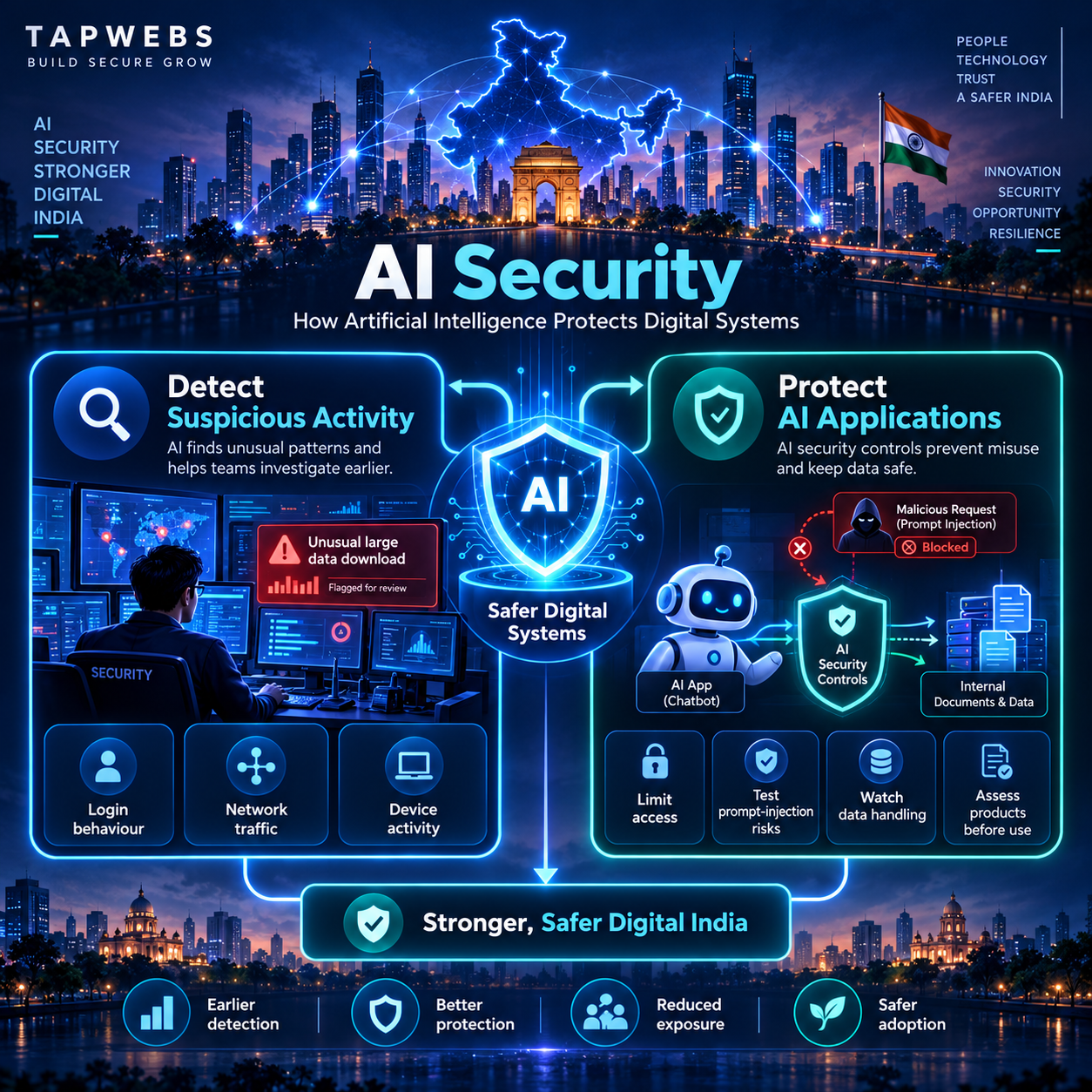
A useful part of AI and Cybersecurity in India is the ability to analyse patterns that might be difficult for a person to notice while reviewing thousands of system events. Depending on the product, AI Security software can examine login behaviour, network traffic and activity on individual devices. For example, an employee's account might suddenly try to download a large amount of customer information at an unusual hour. A monitoring system could flag the activity for review. That does not automatically prove an attack has occurred, but it gives the security team a reason to investigate before the situation develops further.
Protecting AI applications themselves is another part of AI and Cybersecurity in India. A customer-support chatbot may be useful when answering routine questions, but connecting it to internal documents without appropriate restrictions can create unnecessary risks. Someone might try to manipulate the chatbot into revealing information it should not share. Businesses should limit access to sensitive files, test for prompt-injection and data-disclosure risks, and monitor how these applications handle information. Strong AI Security controls can reduce exposure, but they cannot remove every risk. Products from AI Startups in India should therefore be assessed for their security, privacy and operational suitability before being introduced into a business.
| Security Task | The Old Manual Method | The Modern Smart Method |
|---|---|---|
| Finding Vulnerabilities | Checking systems occasionally through manual reviews and scheduled assessments | Combining regular vulnerability scans with risk-based prioritisation and AI-assisted analysis |
| Stopping Account Break-Ins | Discovering suspicious access after a customer or employee reports a problem | Using multifactor authentication, risk-based access controls and alerts for unusual sign-ins |
| Handling Security Alerts | Asking engineers to review large numbers of alerts without clear priorities | Using AI and Cybersecurity analytics to group alerts and highlight activity that needs closer attention |
| Handling Emergencies | Trying to decide what to do while an incident is already unfolding | Following a tested incident-response plan and relevant CERT-In guidance |
AI Startups in India: Opportunities and Security Challenges
The growth of AI and Cybersecurity in India is opening opportunities for technology businesses in cities such as Bengaluru, Hyderabad, Gurugram and Pune. AI Startups in India are exploring areas such as fraud detection, threat monitoring, identity protection and vulnerability management. Some products may be designed around challenges faced by Indian businesses, including regional-language scams and suspicious payment activity. However, a local product is not automatically cheaper, safer or more effective than an international one. Businesses should look at actual capabilities, privacy practices, integration requirements and total costs before making a decision.
For a young technology company, AI and Cybersecurity in India is not just a concern to address after the product becomes popular. Small teams often work under pressure to release features quickly, and security checks can get pushed aside when deadlines approach. An exposed test database or a weak password on a development account may seem like a minor oversight until someone finds it. AI Startups in India should restrict access to sensitive systems, test their applications before launch and keep software updated. AI Security tools can help uncover certain weaknesses, but they work best alongside code reviews, secure configurations and regular maintenance.
The Benefits of AI Cybersecurity for Businesses in India
For many organisations, the practical benefits of AI cybersecurity for businesses in India come down to finding problems earlier and helping staff focus on the issues that matter. A well-configured monitoring system may flag an unusual login or unexpected data transfer before anyone notices a problem manually. That gives the team a chance to investigate and take appropriate action. AI and Cybersecurity tools can support this work, but results depend on how the tools are configured, the information available to them and the team's ability to respond. They should not be treated as a replacement for basic security measures.
Trust is another reason businesses pay attention to AI and Cybersecurity in India. Customers want to know that a company takes the protection of their information seriously, especially when they are sharing payment details or personal records. Clear privacy practices, responsible handling of incidents and sensible security controls all contribute to that trust. Working with AI Startups in India may give a business more ways to address a particular security need, while suitable AI Security measures can help protect applications and data. The best choice is the one that fits the organisation's actual risks, budget and technical requirements.
Key Advantages for Business Owners
- Helps teams notice unusual login attempts and suspicious activity that could otherwise go unnoticed.
- Supports the protection of customer information and business reputation through stronger security practices.
- Helps organisations prepare for relevant CERT-In reporting requirements and incident-response responsibilities.
- Gives businesses more choices by allowing them to evaluate products from AI Startups in India.
- Can reduce some repetitive alert-review work and help security teams prioritise potential threats through AI and Cybersecurity analytics.
- Helps support the reliability of payment links, online stores and customer-facing applications when paired with good maintenance practices.
- Encourages better day-to-day security habits through practical AI Security controls, staff training and regular reviews.
Challenges and Limitations of AI in Cybersecurity in India
Despite its potential, AI and Cybersecurity in India still faces practical challenges. Security tools can generate false alarms, miss unfamiliar threats and require time and money to configure properly. A system that works well in one environment may not perform as expected in another, particularly if the available data is incomplete or the rules are poorly configured. AI Security should therefore be treated as one layer of protection, alongside access controls, timely software updates, tested backups and human investigation. Businesses should review their tools regularly to understand what they detect well and where their limitations lie.
There is also the uncomfortable reality that attackers can use AI for their own purposes. AI and Cybersecurity in India must account for scams that use convincing writing, cloned voices and automated techniques to target people and businesses. Messages written in Hindi, Tamil, Bengali and other languages may sound personal and believable, making them harder to recognise at a glance. Organisations should teach employees to verify unusual requests, maintain reliable backups and follow relevant CERT-In advisories. When evaluating AI Startups in India, businesses should also ask how their products handle data, what their limitations are and what support is available if something goes wrong.
Trends in AI and Cybersecurity in India to Watch in 2026
One area attracting attention in AI and Cybersecurity in India is the growing use of AI agents that can perform tasks across different applications. These tools may help staff process customer requests, summarise documents or handle routine administrative work. The risk appears when an assistant has access to more information or permissions than it actually needs. Businesses should limit each tool's access, review its external connections and test how it responds to untrusted instructions. Appropriate AI Security controls, combined with monitoring and human oversight, can help keep these systems within clearly defined boundaries.
Another important area for AI and Cybersecurity in India is software supply-chain security. A website or application may rely on dozens of libraries, plugins and third-party components, and an outdated dependency can introduce a weakness even when the main application appears secure. Keeping an inventory of these components makes it easier to identify updates and investigate known vulnerabilities. Businesses should combine this practice with regular assessments and relevant CERT-In advisories. AI Startups in India may provide tools to assist with parts of the process, but organisations should check their accuracy, compatibility and data-handling practices before relying on them.
Steps to Take After a Security Incident
| Timeframe | What Your Team Should Do | Expected Outcome |
|---|---|---|
| First 0 to 6 hours | Activate the incident-response plan, assess the situation, contain affected systems carefully, preserve relevant evidence and report applicable incidents to CERT-In within the required deadline | Limit further harm, preserve evidence and meet applicable reporting obligations |
| Days 1 to 3 | Review system logs, investigate the likely entry point, identify affected accounts and systems, and seek qualified forensic support when needed | Understand the scope of the incident and identify the weaknesses that need attention |
| Days 4 to 7 | Remove the cause of compromise, patch affected systems, reset credentials as appropriate, verify clean backups and restore services carefully | Resume operations while reducing the risk of immediate reinfection |
| Week 2 | Review AI Security settings, update response procedures, train staff and document lessons learned | Improve future readiness through stronger AI and Cybersecurity practices |
How AI Startups in India Can Improve Cybersecurity
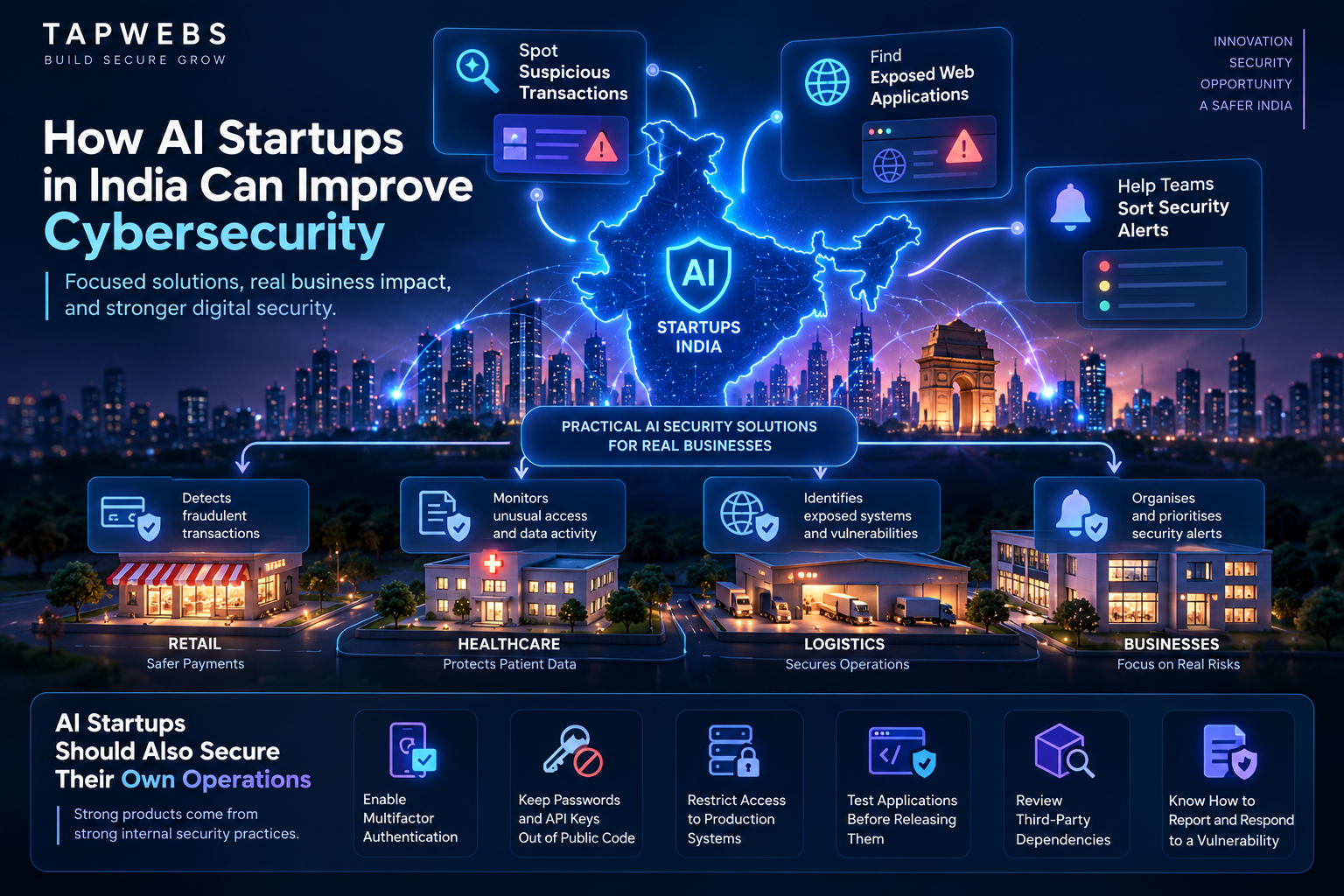
AI and Cybersecurity in India can move forward when technology founders focus on problems that businesses genuinely face. Rather than building a platform that claims to solve every security issue, AI Startups in India can concentrate on specific tasks such as spotting suspicious transactions, finding exposed web applications or helping teams sort through security alerts. For a small retailer, hospital or logistics company, a tool that solves one clear problem may be more useful than a complicated system with features the team never uses. Its value should be judged through practical testing, clear limitations and evidence of how well it performs.
The teams building these products also need to take AI and Cybersecurity in India seriously within their own operations. Founders should enable multifactor authentication, keep passwords and API keys out of public code repositories, restrict access to production systems and test applications before releasing them. Third-party dependencies should be reviewed, and the team should know how to report and respond to a vulnerability. AI Security tools can support this work, but they do not replace secure development practices. AI Startups in India should protect their own systems and customer information with the same care they expect their customers to apply.
Essential Security Checklist for Every Team
- Keep database credentials, API keys and other secrets out of public code repositories.
- Enable multifactor authentication for employee email, cloud services and administrative accounts.
- Restrict internet access and permissions for internal testing systems and AI applications where appropriate.
- Scan repositories and deployed applications for exposed credentials and known vulnerabilities.
- Enable and securely retain ICT system logs for the applicable 180-day period where the relevant CERT-In directions require it.
- Compare products from AI Startups in India against your business needs, security requirements and budget before choosing a solution.
- Train employees to recognise phishing attempts, impersonation scams and suspicious payment requests.
- Review AI Security controls regularly, keep software updated and maintain tested backups and an incident-response plan.
Frequently Asked Questions
What role does CERT-In play in regulating AI and cybersecurity in India?
CERT-In is India's national computer emergency response agency. It coordinates aspects of cybersecurity incident response and publishes advisories, vulnerability information and security guidance. Under its 2022 directions, specified categories of cyber incidents must be reported within six hours of being noticed or brought to an organisation's attention. Businesses should establish which requirements apply to them and use relevant CERT-In guidance when developing their AI and Cybersecurity plans.
How do Indian AI startups help improve digital security?
AI Startups in India may develop tools for threat detection, fraud monitoring, vulnerability assessment and security automation. Some products focus on problems relevant to the local market, such as suspicious payment activity or regional-language scams. However, businesses should not choose a product on its origin alone. They should check the provider's security capabilities, data-handling practices, reliability and cost before integrating it into their AI and Cybersecurity systems.
What is the most important step for improving enterprise AI security?
There is no single measure that can protect every enterprise AI system. A sensible starting point is to limit access to sensitive information, give applications only the permissions they need, protect credentials and test systems for possible misuse. Organisations should also monitor activity, train employees and maintain an incident-response process. These AI Security measures should be part of a wider AI and Cybersecurity programme rather than treated as a complete solution on their own.
Why is AI cybersecurity better than traditional antivirus software?
AI-assisted cybersecurity tools can analyse behaviour and flag unusual patterns that traditional signature-based antivirus software may not recognise. However, traditional antivirus remains useful for detecting known threats, so the two approaches can complement each other. The effectiveness of AI and Cybersecurity depends on the tools selected, how they are configured, the quality of monitoring and how promptly a team investigates and responds to alerts.
Conclusion
AI and Cybersecurity in India matters because businesses increasingly depend on digital services to manage payments, communicate with customers and store important information. Keeping software updated, protecting accounts, monitoring systems and preparing for incidents are practical steps any organisation can take. Understanding the relevant CERT-In requirements and choosing suitable AI Security tools can strengthen these efforts. The important thing to remember is that no product can promise to prevent every attack, and even a well-protected business needs a plan for responding when something goes wrong.
In the end, AI and Cybersecurity in India works best when technology supports people rather than replacing their judgement. Businesses should assess AI Startups in India on their actual capabilities, security practices and suitability for the job instead of relying on marketing promises. With sensible controls, regular reviews and a team that knows what to do when an alert appears, organisations can reduce avoidable risks and build a more resilient foundation for digital growth in 2026.