Generative Engine Optimization (GEO): How to Get Cited by ChatGPT, Perplexity and Google AI Overviews
Search is changing from blue links to AI-generated answers. Learn how Generative Engine Optimization (GEO), strong content, structured information and traditional SEO can help your business become more discoverable across AI-powered search experiences.
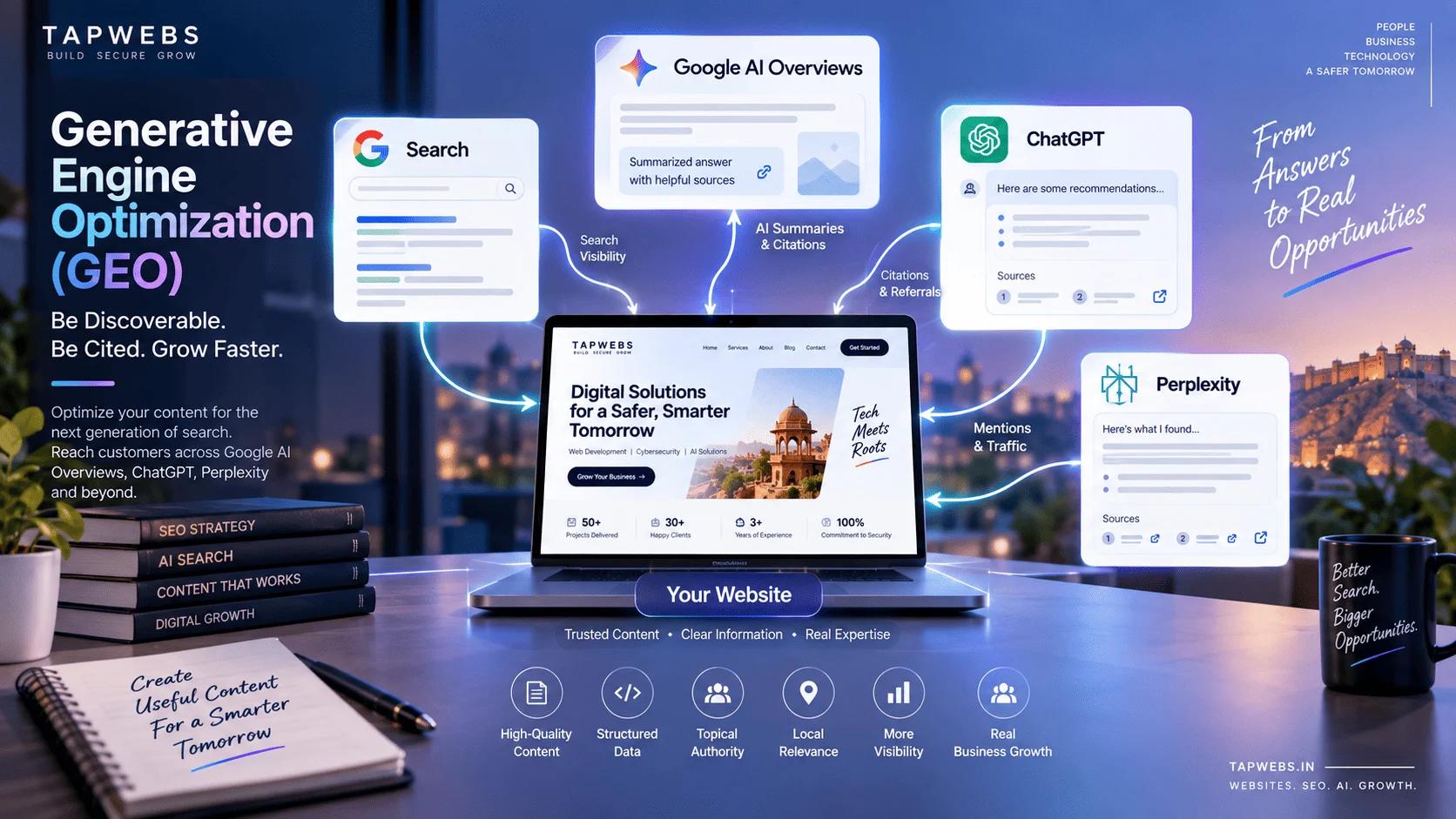
What Is Generative Engine Optimization?
Search is no longer limited to a list of ten blue links.
People can now ask questions in conversational interfaces and receive synthesized answers that include links to supporting sources.
For example, instead of searching:
"best cybersecurity company Jaipur"
a user might ask:
"Which cybersecurity companies in Jaipur help startups with website security and vulnerability testing?"
The search experience can then combine information from multiple sources and present an answer in a conversational format.
This has created a new area of search optimization commonly called Generative Engine Optimization (GEO).
GEO focuses on making a website's information:
- Easy to understand
- Clearly structured
- Useful to humans
- Supported by evidence
- Relevant to specific questions
- Discoverable by search systems
- Easy for AI systems to interpret and reference
However, GEO should not be treated as a completely separate replacement for SEO.
Google's current guidance explicitly says that the same foundational SEO practices remain relevant for appearing in its AI-powered Search experiences.
A useful way to visualize the relationship is:
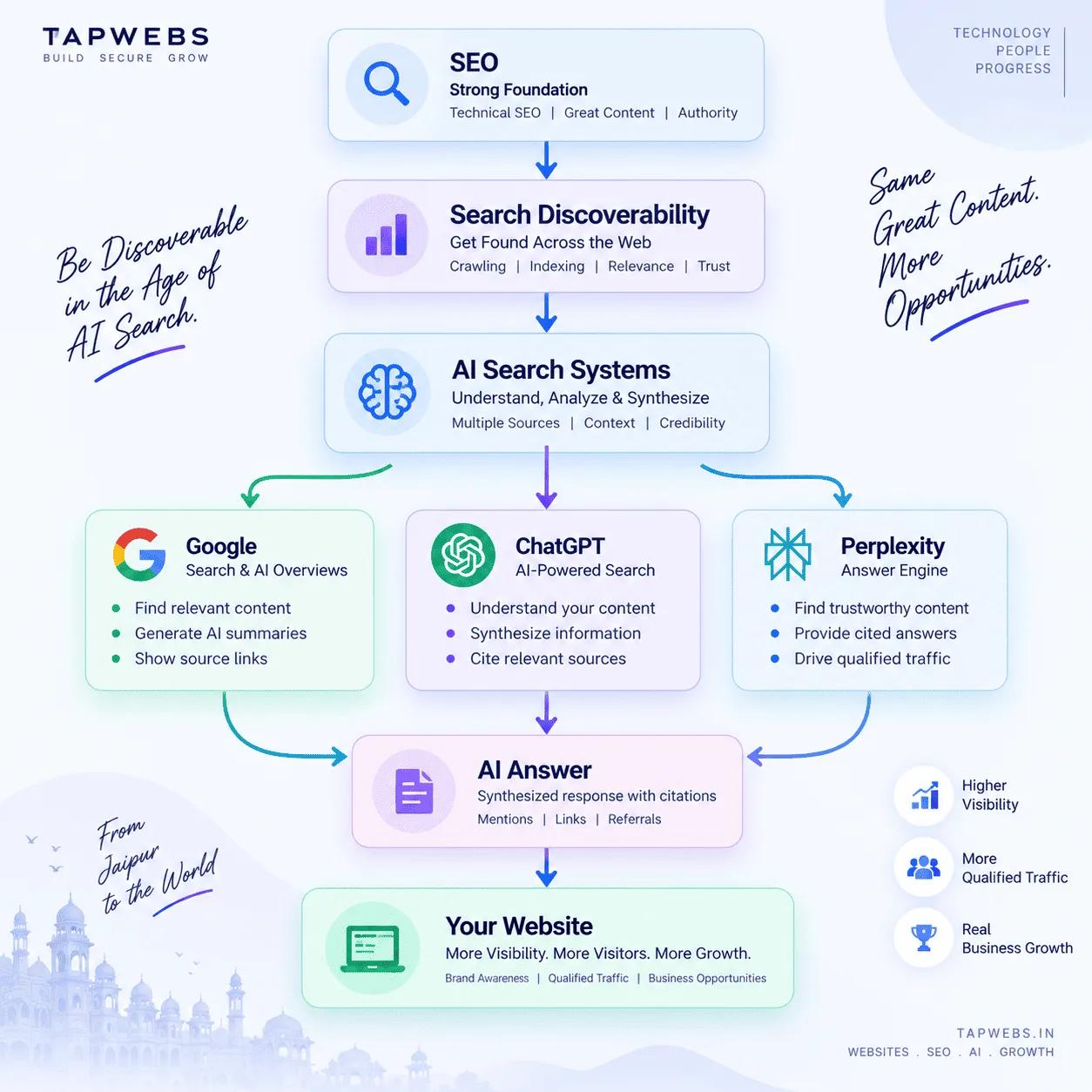
GEO vs SEO: What Is the Difference?
SEO and GEO have a significant amount of overlap, but they focus on different search experiences.
| Area | Traditional SEO | GEO |
| Primary environment | Search engines | AI-powered search and answer systems |
| Main goal | Improve search visibility | Improve likelihood of being surfaced or cited |
| Core content | Helpful web pages | Helpful, answer-oriented information |
| Keywords | Important | Still useful, but context matters more |
| Structure | Important | Extremely important for interpretation |
| Links | Important | Important for discovery and credibility |
The distinction is important because GEO does not mean abandoning SEO.
Google's documentation now specifically addresses optimization for generative AI features and states that SEO best practices continue to be relevant.
How AI Search Changes the Customer Journey
Traditional search often looks like this:
User -> Google Search -> Search Results -> Website -> Customer
AI-powered search can introduce another layer:
User Question -> AI Search -> Multiple Sources -> Synthesized Answer -> Cited / Linked Sources -> Website -> Customer
ChatGPT Search, for example, provides answers with links to relevant web sources, allowing users to continue from an AI-generated response to the original publisher or website.
This changes an important part of SEO strategy.
A business is no longer optimizing only for:
"How do I rank for this keyword?"
It can also ask:
"Does my website clearly answer the questions people are asking?"
How ChatGPT, Perplexity and Google AI Search Use Websites
Different AI search systems have different architectures and ranking systems.
There is therefore no universal GEO formula that guarantees a website will be cited.
For example, OpenAI states that ChatGPT Search ranks results using multiple factors and that placement is not guaranteed; websites should allow the relevant OpenAI search crawler to access content if they want that content to be discoverable in ChatGPT Search.
Google similarly treats its AI features as part of Google Search rather than as a completely separate optimization ecosystem. Its documentation emphasizes useful content, technical accessibility and established SEO practices.
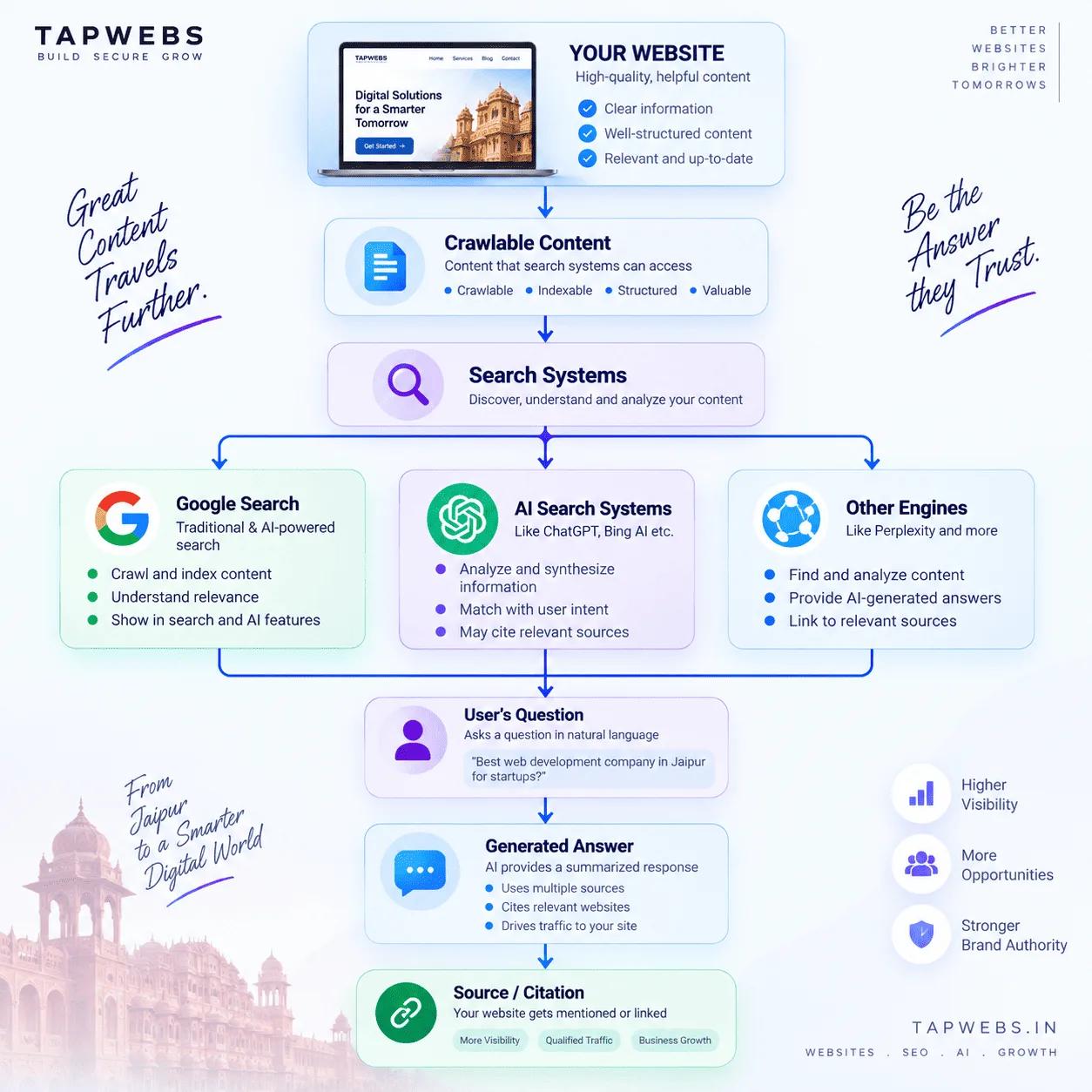
The key objective is therefore not to "trick" an AI system into mentioning a company.
It is to publish information that is useful, accessible, clear and trustworthy enough to be considered a relevant source.
What Makes a Website More Understandable to AI Systems?
AI systems need to interpret information before they can use it.
A page containing a large block of vague marketing copy is harder to interpret than a page with clearly defined information.
Compare:
We provide world-class digital solutions for businesses looking to grow online.
with:
Website Development in Jaipur We build business websites for startups, SMEs and local businesses. Services: - Business websites - E-commerce websites - Website maintenance - Local SEO
The second example communicates:
- What the business does
- Where it operates
- Who it serves
- Which services it provides
This creates stronger contextual signals for both humans and search systems.
The Role of Helpful and Original Content
One of the biggest mistakes in GEO is assuming that repeating keywords will make a website more visible in AI search.
It won't create a reliable strategy.
Instead, create content that actually contributes information.
Useful content can include:
- Original research
- Expert explanations
- Practical guides
- Case studies
- Comparisons
- Industry observations
- Local information
- First-hand experience
- Original statistics
- Examples
- Step-by-step processes
Google's current AI-search guidance specifically highlights the importance of non-commodity content and continuing to follow established search best practices.
Think about the difference between:
Generic content
SEO is important for businesses because it helps them get visibility online.
and:
Useful content
A Jaipur jewellery business targeting customers searching for "jewellery showroom near MI Road" should build location-specific service content, maintain an accurate Business Profile and provide clear information about its products, location, opening hours and contact methods.
The second provides actual information that can answer a real question.
Common GEO Mistakes to Avoid
1. Keyword stuffing
Repeating "GEO", "AI search" and "ChatGPT" dozens of times does not create useful content.
2. Creating hundreds of nearly identical pages
Programmatically producing pages with little unique value can create low-quality content rather than useful topical coverage.
3. Writing only for AI
Your first audience should still be people.
If humans cannot understand the page, optimizing it for machines will not solve the underlying problem.
4. Making unsupported claims
Avoid statements such as:
"This technique guarantees ChatGPT will cite your website."
AI search systems change their behavior and ranking systems.
No legitimate GEO strategy can guarantee citation placement.
5. Ignoring technical SEO
A website that cannot be properly crawled, indexed or understood has a weak foundation for both traditional and AI search.
6. Publishing generic AI-generated articles
Using AI to assist with writing is different from publishing large quantities of generic content without meaningful value.
Google's current documentation continues to emphasize quality, originality and people-first content while applying its spam policies to generative AI search experiences as well.
Conclusion
Generative Engine Optimization is best understood as an extension of the broader shift toward AI-powered discovery.
Businesses need to make their websites understandable not only to search engines, but also to users asking increasingly conversational questions.
That means creating:
- Useful service pages
- Original educational content
- Clear business information
- Strong internal linking
- Structured data where appropriate
- Local context
- Evidence and expertise
- Technically accessible websites
There is no single trick that guarantees a citation in ChatGPT, Perplexity or Google AI features.
Instead, the long-term opportunity is to build a website that consistently provides clear, useful and trustworthy information.
The goal of GEO is not to manipulate AI answers. It is to make your business a genuinely useful source when people ask questions.