Beyond Chatbots: The New Generation of AI Systems That Can Reason, Code, Search and Act
AI is moving beyond chatbots. The latest frontier systems can reason through complex problems, write and test code, search the web, operate computers, use tools and execute multi-step workflows. Here’s how GPT-6 Astra, Claude Fable 5.1, Gemini 3.8 Flash, Grok 4.6 and Meta Muse compare.
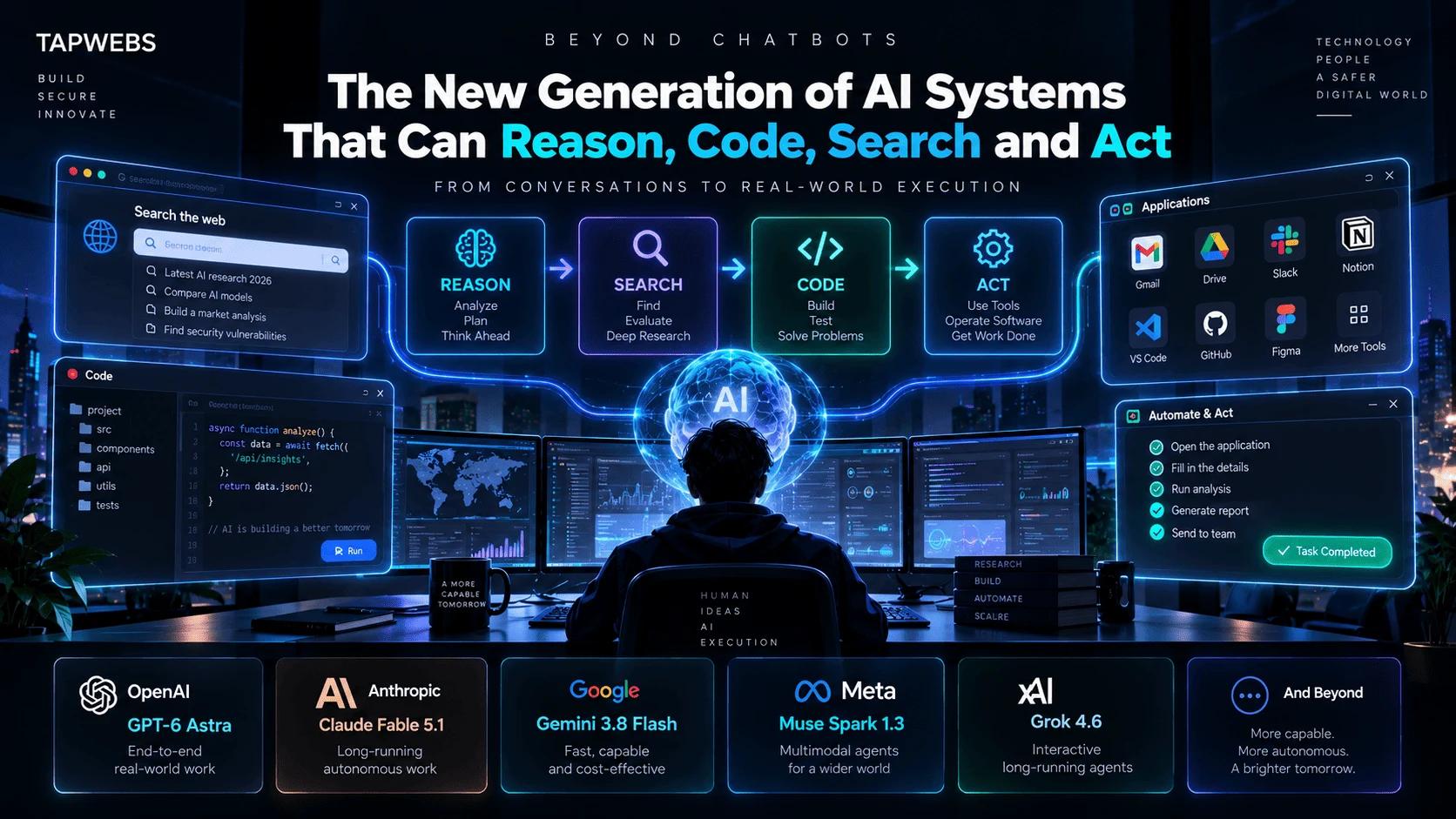
Beyond Chatbots: The New Generation of AI Systems That Can Reason, Code, Search and Act
The first generation of generative AI made computers dramatically better at producing information.
Ask a chatbot a question and it could write an answer. Ask it to summarize a document and it could summarize it. Give it a programming problem and it could generate code.
That model is changing.
In 2026, the most advanced AI systems are increasingly designed around a different loop:
Reason → Search → Use tools → Write code → Operate software → Verify → Act
The result is a new class of AI systems that are less like traditional chatbots and more like digital operators.
OpenAI's GPT-6 Astra can perform complex computer-use, coding, research and professional workflows. Anthropic's Claude Fable 5.1 is optimized for long-running projects spanning multiple applications. Google's Gemini 3.8 Flash targets reasoning, coding and autonomous agents at lower cost. Grok 4.6 focuses heavily on long-running agents and interactive work, while Meta's Muse family is pushing multimodal reasoning, coding and computer-use agents.
The important question is no longer:
“Which chatbot is smartest?”
It is:
“Which AI system can reliably complete the most useful work?”
From Chatbots to AI Systems
The difference between a traditional chatbot and a modern AI agent is easiest to understand as a workflow.
| Capability | Traditional Chatbot | Modern AI System |
| Answer questions | ✅ | ✅ |
| Generate text | ✅ | ✅ |
| Analyze files | Limited | Advanced |
| Reason through complex problems | Some | Strong |
This is the fundamental architectural shift.
A chatbot generally produces a response.
An agentic AI system attempts to complete an objective.
The Frontier AI Landscape in September 2026
Several leading systems now approach the same problem from very different directions.
| AI System | Primary Strength | Reasoning | Coding | Search | Computer Use | Long-Running Agents |
| GPT-6 Astra | End-to-end professional work | ★★★★★ | ★★★★★ | ★★★★★ | ★★★★★ | ★★★★★ |
| Claude Fable 5.1 | Long-running knowledge + coding | ★★★★★ | ★★★★★ | ★★★★☆ | ★★★★★ | ★★★★★ |
| Gemini 3.8 Flash | Fast agentic reasoning | ★★★★★ | ★★★★★ | ★★★★★ | ★★★★★ | ★★★★★ |
| Grok 4.6 | Interactive long-running agents | ★★★★☆ | ★★★★★ | ★★★★☆ | ★★★★☆ | ★★★★★ |
| Muse Spark 1.3 | Multimodal agentic coding | ★★★★☆ | ★★★★★ | ★★★★☆ | ★★★★★ | ★★★★★ |
These ratings are qualitative editorial comparisons, not standardized benchmark scores.
The more interesting story is why each system is being optimized differently.
1. GPT-6 Astra: The General-Purpose AI Operator
OpenAI's GPT-6 Astra, launched September 3, represents one of the clearest attempts to combine reasoning, coding, browsing, computer use and professional workflows into a single frontier model.
Astra has a 1.05-million-token context window and supports up to 128,000 output tokens. Its API pricing is $10 per million input tokens and $50 per million output tokens.
More importantly, Astra isn't positioned simply as a better conversational model.
OpenAI designed it for:
- Complex reasoning
- Software engineering
- Computer use
- Web browsing
- Research
- Data analysis
- Document creation
- Presentations
- Spreadsheet workflows
- Professional automation
OpenAI reports 98% on FrontierMath Tier 4, 99.9% on ARC-AGI-3, and 100% on ExploitBench.
On OpenAI's published comparison, Astra scored:
- 72.6% on OSWorld 2.0 partial score
- 91.5% on BrowseComp
- 41.4% on AutomationBench
- 95.9% on BenchCAD
What makes Astra different?
The interesting capability isn't any single benchmark.
It is the combination.
Astra can potentially take:
“Research these companies, compare their security architectures, build a spreadsheet, create a presentation and summarize the recommendations.”
and treat that as one workflow rather than five separate prompts.
That is a significant departure from chatbot-style AI.
2. Claude Fable 5.1: AI Designed to Stay on the Job
Anthropic is attacking the problem from another direction.
Claude Fable 5.1 is explicitly designed for ambitious, long-running projects.
Anthropic describes it as a model capable of jobs that take hours and span multiple applications, including browser operation, coding projects, research and managed agents.
Fable 5.1 can:
- Plan multi-step work
- Use tools
- Operate browsers
- Recover when a step fails
- Write and run tests
- Review its own coding work
- Analyze documents
- Handle diagrams and PDFs
- Continue multi-day coding sessions
Its API price is $10 per million input tokens and $50 per million output tokens, matching Astra's standard token pricing. Anthropic says cache reads are $0.25 per million tokens, and estimates that this can reduce typical workload costs by around 25% and highly agentic workload costs by up to approximately 45% compared with Fable 5.
Why this matters
Long-running work changes the economics and design of AI.
Imagine asking an AI to investigate a large software repository.
A chatbot might:
- Read some files
- Suggest a change
- Stop
A long-running coding agent can instead:
- Inspect the repository
- Build a plan
- Modify multiple files
- Write tests
- Run the tests
- Analyze failures
- Fix the implementation
- Re-run tests
- Review the result
- Deliver the finished change
The model becomes less like a copilot and more like a junior autonomous engineer.
3. Gemini 3.8 Flash: Intelligence at Agent Scale
Google's Gemini 3.8 Flash, released September 2, is perhaps the most interesting example of another major trend:
frontier capability at lower inference cost.
Google calls 3.8 Flash its best reasoning and coding model to date while maintaining the same introductory pricing as 3.7 Flash: $0.75 per million input tokens and $3.75 per million output tokens.
That is dramatically cheaper than the $10/$50 pricing of GPT-6 Astra and Claude Fable 5.1.
Gemini 3.8 Flash focuses on:
- Software engineering
- Agentic tasks
- Multi-step reasoning
- Long-horizon coding
- Professional workflows
- Computer use
- Specialized domains
Google reports 54.9% on HLE-Verified, while also highlighting strong results on software engineering and professional agent benchmarks.
But there is another major development.
Gemini 3.8 Flash Cyber: AI Becomes a Cybersecurity Operator
Google launched Gemini 3.8 Flash Cyber alongside the standard model.
It is specifically optimized for cybersecurity work such as:
- Vulnerability discovery
- Code analysis
- Automated patching
- Security research
Google reports that the model achieved a 47.2% pass@1 on CWE-Bench, close to a leading frontier model's 47.8%, while being substantially cheaper.
Google also says its internal testing across codebases covering 20 programming languages produced a vulnerability-discovery success rate above 70%.
One particularly striking example came from Google's Cloud Vulnerability Research team, which used the model to identify a critical foundational vulnerability in less than two hours, compared with research and discovery processes that can traditionally take months.
This demonstrates an important transition:
AI isn't just generating security advice anymore.
It can increasingly participate directly in the security engineering loop.
4. Grok 4.6: Long-Running Interactive AI
xAI's Grok 4.6 takes another approach.
Released in August 2026, Grok 4.6 was specifically optimized for long-running agents and ambitious interactive and visual work.
xAI says Grok 4.6 can stay with complex tasks involving:
- Research
- Data analysis
- Large codebases
- Application development
- Work artifacts
- Interactive workflows
The model reportedly matches GPT-5.6 Sol on the Artificial Analysis Intelligence Index, a composite benchmark covering nine evaluations.
The important distinction is product philosophy.
Grok is increasingly being positioned not simply as an answer engine, but as an AI capable of staying inside a project.
That matters because real work is rarely one prompt long.
5. Meta Muse: Multimodal AI That Can Actually Use Computers
Meta's Muse family represents a particularly aggressive move toward multimodal agents.
Muse Spark was introduced as a natively multimodal reasoning model supporting:
- Tool use
- Visual reasoning
- Multi-agent orchestration
Then Meta introduced Muse Spark 1.1, improving tool use, computer use, coding and multimodal understanding.
The evolution continued with Muse Spark 1.2 and then Muse Spark 1.3.
Meta now describes Muse Spark 1.3 as being trained for long-horizon agentic workflows, with the ability to track context and previous results, work through messy or conflicting inputs, and ask for user input when necessary.
Meta's Muse Code takes this into software development.
It can coordinate multiple agents to:
- Plan code changes
- Implement them
- Validate them
- Work across multiple files
- Operate in large repositories
This is important because Meta isn't simply building a better coding chatbot.
It is building an agentic development environment around the model.
Reasoning Is Becoming a Compute Strategy
One of the biggest changes in modern AI is that reasoning is increasingly treated as something the model can scale at inference time.
Traditional LLM:
Prompt → Generate answer
Reasoning model:
Prompt → Think → Evaluate → Continue reasoning → Generate answer
Agentic reasoning:
Goal → Plan → Tool → Observe → Reason → Tool → Observe → Reason → Verify → Act
That means intelligence increasingly depends on how much computation a system is willing to spend on the task.
Google explicitly describes Gemini 3.8 Flash as working harder on difficult problems, including additional reasoning steps and iterative tool calls.
This creates a new optimization problem:
How much reasoning should an AI spend on a task?
For a simple question, seconds of reasoning may be wasteful.
For a cybersecurity vulnerability, software deployment or financial analysis, it may be essential.
Search Is Becoming Part of the Reasoning Loop
Search used to be something users did before talking to AI.
Now search is increasingly something AI systems perform during reasoning.
A modern research workflow can look like:
Question
↓
Search
↓
Read sources
↓
Compare information
↓
Identify missing evidence
↓
Search again
↓
Reason
↓
Produce answer
This changes the relationship between AI and search engines.
Google is integrating Gemini directly into Search, while frontier AI systems increasingly combine models with web-search tools and retrieval systems. Google's I/O 2026 Search updates explicitly positioned Gemini 3.5 Flash as the default model for AI Mode and expanded search inputs beyond text to include images, files, videos and Chrome tabs.
The search engine is therefore becoming less of a destination and more of a tool available to an AI agent.
Coding Is Becoming an Autonomous Loop
Coding may be the clearest demonstration of this transformation.
Old AI coding:
“Write this function.”
Modern AI coding:
“Implement this feature in the repository.”
The difference is enormous.
A capable coding agent can:
- Inspect the codebase
- Identify dependencies
- Create an implementation plan
- Modify multiple files
- Run tests
- Read compiler errors
- Debug
- Search documentation
- Review changes
- Repeat the cycle
Meta's Muse Code, Anthropic's Claude coding workflows, OpenAI Codex/Astra, Google's Antigravity ecosystem and Grok's software-generation capabilities are all moving toward this model.
The programming language is increasingly becoming less important than the ability to describe the desired outcome.
But Are These AI Agents Actually Reliable?
This is where the hype needs to meet reality.
The answer is:
Not yet.
OSWorld 2.0 provides an unusually useful reality check.
The benchmark contains 108 long-horizon computer-use workflows representing realistic professional and everyday tasks.
The median human completion time is around 1.6 hours, and tasks require an average of 318 tool calls with Claude Opus 4.7 under maximum-thinking evaluation—roughly an order of magnitude more interaction than the original OSWorld benchmark.
The strongest result reported in the paper was only 20.6% binary completion at 500 steps for Claude Opus 4.8 with maximum thinking and batched tool calls, with a 54.8% partial score. GPT-5.5 was around 13% on the same primary completion metric.
That tells us something extremely important.
Modern AI agents can be spectacular at individual tasks.
But reliable autonomy across long, messy workflows remains unsolved.
The Security Problem Gets Bigger as AI Gets Smarter
There is an uncomfortable side effect to all this progress.
The more AI can act, the more dangerous mistakes become.
A chatbot producing a wrong answer is one type of failure.
An AI agent that can:
- Read private files
- Execute commands
- Browse websites
- Send email
- Modify databases
- Deploy code
- Find vulnerabilities
- Make purchases
can turn an incorrect decision into an actual incident.
OpenAI now classifies GPT-6 Astra as reaching the Critical level of cybersecurity capability under its Preparedness Framework and says the model can, with the right tools and access, discover previously unknown vulnerabilities and develop exploitation techniques without step-by-step human guidance.
Google's Gemini 3.8 Flash Cyber is similarly being deployed under a restricted Fairwind Program for trusted defenders.
This is why modern AI development increasingly requires:
- Sandboxed execution
- Permission controls
- Human approval
- Monitoring
- Audit logs
- Prompt-injection defenses
- Tool restrictions
- Environment isolation
- Verification
The future of AI isn't simply more autonomy.
It is controlled autonomy.
The New AI Stack
The architecture of advanced AI systems is also changing.
Instead of:
LLM → Answer
we are moving toward:
Model
↓
Reasoning
↓
Memory / Context
↓
Search / Retrieval
↓
Tools / APIs
↓
Computer Use
↓
Execution Environment
↓
Verification
↓
Human Approval
This stack explains why comparing models only by chatbot responses is becoming increasingly misleading.
A model may be excellent at reasoning but weak at computer use.
Another may be cheaper but require more steps.
Another may have better multimodal perception.
Another may have better coding agents.
The system around the model can matter as much as the model itself.
What Comes After the Chatbot?
The next generation of AI products will increasingly look less like chat windows.
They will look like:
- Research agents
- Coding agents
- Security agents
- Browser agents
- Enterprise operators
- Personal assistants
- Multi-agent development environments
- Autonomous workflow systems
The user experience also changes.
Instead of saying:
“Write a report about these companies.”
You may say:
“Research the market, verify the sources, compare the competitors, build the analysis, create the presentation and send me the final version.”
The AI becomes responsible for the workflow, not just the response.
The Bigger Shift: AI Is Becoming an Execution Layer
The most important development in AI isn't that models are becoming better conversationalists.
It is that AI is becoming an execution layer between humans and software.
Humans traditionally interact with software through:
Menus → Buttons → Forms → APIs → Commands
AI agents increasingly provide another interface:
Intent → Reasoning → Action
That could eventually change how software itself is designed.
Instead of learning how to operate ten different applications, users may increasingly describe what they want and let an AI agent coordinate the underlying tools.
This is the real significance of computer-use AI.
Final Verdict
The AI industry has moved beyond the simple chatbot race.
GPT-6 Astra is pushing toward end-to-end professional work. Claude Fable 5.1 is designed for long-running coding and knowledge workflows. Gemini 3.8 Flash demonstrates how agentic capability can become dramatically cheaper. Grok 4.6 focuses on long-running interactive work. Meta's Muse family is combining multimodal reasoning, computer use and multi-agent coding.
But the benchmark reality is equally important.
AI agents can now do things that would have looked impossible only a few years ago.
They can reason.
They can search.
They can code.
They can operate computers.
They can use tools.
They can work for hours.
But they still struggle with the hardest part of intelligence:
reliably knowing what to do next when the environment changes.
That is the next frontier.
The future isn't simply AI that can answer anything.
It is AI that can understand a goal, plan the work, execute it, verify the result and know when it should ask a human for help.
Tags