AI-Powered Cyberattacks in 2026: How Hackers Are Using AI to Find and Exploit Vulnerabilities
AI is changing the speed and scale of cyberattacks. Learn how threat actors are using AI for reconnaissance, phishing, vulnerability research and adaptive malware—and what businesses can do to strengthen their defenses.
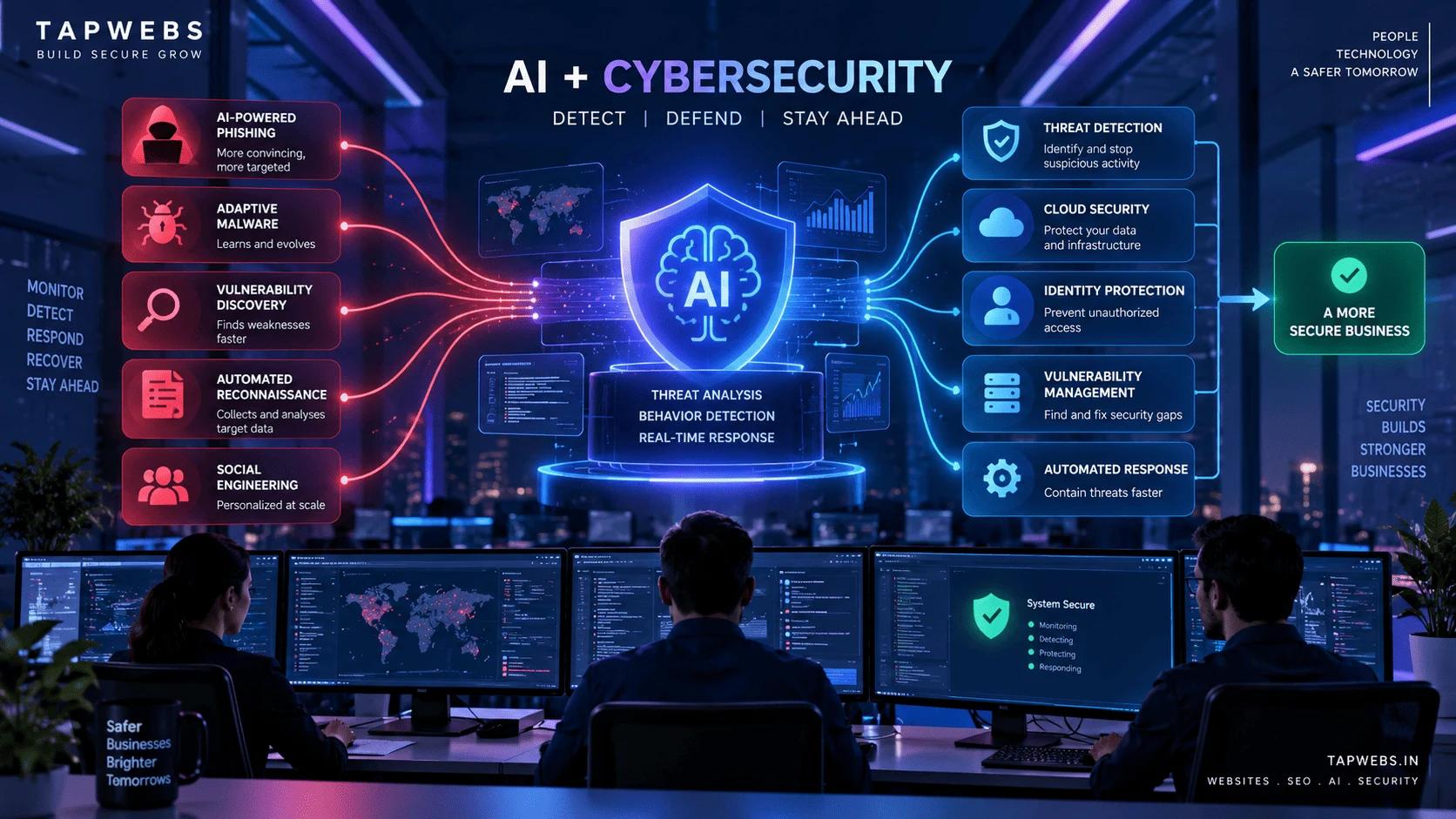
How AI Is Changing Cyberattacks
Artificial intelligence is becoming part of both sides of cybersecurity.
Security teams are using AI to analyze large volumes of security data, prioritize alerts, investigate incidents and automate repetitive tasks.
Attackers are using the same underlying technology to improve parts of the attack lifecycle.
Google Threat Intelligence reported that during 2025, threat actors moved from primarily experimenting with AI toward integrating AI into operational activity, including reconnaissance, social engineering and malware development.
Microsoft's 2025 Digital Defense Report similarly identifies increased use of AI by threat actors to scale phishing and automate aspects of intrusion activity.
The important change is therefore not simply:
"Hackers now have AI."
It is:
AI can reduce the time, effort and expertise required for several stages of an attack.
How Attackers Are Using AI
AI can support different stages of the cyberattack lifecycle.
| Attack Stage | Potential AI Use |
| Reconnaissance | Organizing publicly available information |
| Target research | Understanding technologies and environments |
| Social engineering | Generating convincing, personalized messages |
| Phishing | Creating and translating deceptive content |
| Code development | Assisting with scripts and malware development |
Google Threat Intelligence has documented AI use across multiple stages of the attack lifecycle and reported the emergence of malware that can query LLMs during execution.
This does not mean every cyberattack is autonomous or AI-powered.
Traditional vulnerabilities, stolen credentials, misconfigurations and exposed services remain important attack paths.
AI is increasingly acting as a force multiplier around those existing weaknesses.
AI-Powered Attack Lifecycle
A simplified model of an AI-assisted attack looks like this:
Target -> Reconnaissance -> AI-Assisted Research -> Social Engineering / Exploitation -> Initial Access -> Persistence -> Data Access -> Impact
The specific techniques used by an attacker vary considerably, but AI can potentially accelerate several stages.
This creates a major defensive challenge: security teams may have less time to detect and respond before an attack progresses.
Google's 2026 threat reporting describes AI as accelerating reconnaissance, vulnerability discovery and exploit development, increasing pressure on defenders to reduce exposure and improve response speed.
AI-Powered Phishing and Social Engineering
Phishing is not a new threat.
What has changed is the quality and scalability of the content attackers can produce.
Generative AI can help create:
- More natural-sounding messages
- Multilingual phishing content
- Personalized social-engineering messages
- Fake business communications
- Convincing support conversations
- Synthetic images and media
- Impersonation content
Microsoft's 2025 reporting highlights the increased use of AI for phishing, social engineering and other forms of cyber-enabled fraud.
Previously, suspicious grammar or awkward wording could sometimes help employees identify a phishing message.
That signal is becoming less reliable.
What businesses should do
Organizations should move away from relying primarily on:
"Can employees spot bad grammar?"
Instead, security controls should verify:
- Sender identity
- Domain authenticity
- Authentication signals
- Links and destinations
- Login context
- Unusual requests
- Payment changes
- Sensitive-data requests
Employee awareness remains important, but it should be combined with technical controls.
AI-Assisted Reconnaissance
Before attempting to compromise a target, attackers often need to understand the environment.
Public information can reveal:
- Technologies
- Domains
- Subdomains
- Employees
- Public documents
- Cloud services
- Exposed applications
- Technology versions
- Business relationships
AI can help organize and analyze large amounts of information much faster.
For defenders, this creates an important lesson:
Your public attack surface is part of your security posture.
A business may have strong authentication and secure internal systems while accidentally exposing unnecessary information through:
- Old subdomains
- Test environments
- Public cloud storage
- Outdated software
- Development endpoints
- Unnecessary services
- Leaked credentials
- Excessive technical information
Regular attack-surface management therefore becomes increasingly important.
AI and Vulnerability Discovery
One of the most important developments is the growing ability of AI models to assist with vulnerability research.
Google Cloud reported in April 2026 that general-purpose AI models are increasingly capable of identifying software vulnerabilities and assisting with exploit development.
Google's 2026 zero-day review also expects AI to accelerate reconnaissance, vulnerability discovery and exploit development, while noting that defenders can use similar capabilities to identify and remediate vulnerabilities before exploitation.
This creates an increasingly important race:
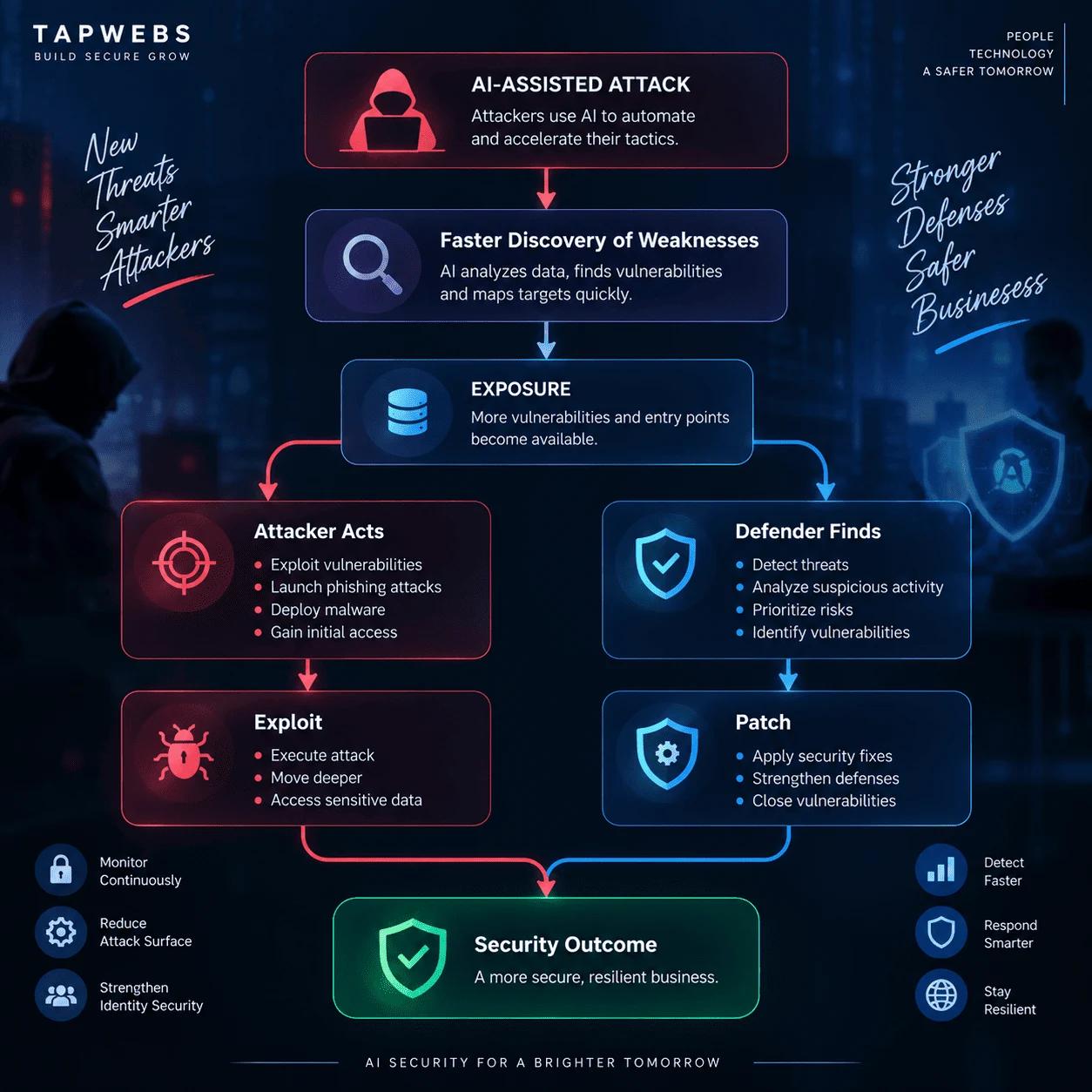
The practical implication for businesses is straightforward:
Finding vulnerabilities after attackers discover them is increasingly risky.
Organizations should therefore move toward continuous vulnerability identification and remediation rather than relying only on occasional security assessments.
Why AI Changes the Cybersecurity Equation
AI does not magically create sophisticated attackers.
Instead, it can lower the cost of performing certain tasks.
Consider a simplified comparison:
| Traditional Attack Workflow | AI-Assisted Workflow |
| Manual research | AI-assisted information processing |
| Manually written messages | Rapid content generation |
| Manual translation | Automated translation |
| Manual code analysis | AI-assisted analysis |
A security team may have hundreds or thousands of systems to protect, while an attacker can use automation to examine targets at scale.
That is why automation must also become part of defense.
The AI Attack Surface for Businesses
Businesses adopting AI create another security layer that needs protection.
The attack surface can include:
- AI applications
- LLM APIs
- AI agents
- Plugins and integrations
- Internal AI tools
- Vector databases
- Model endpoints
- Sensitive prompts
- Training or reference data
- Third-party AI services
How Businesses Can Defend Against AI-Powered Attacks
There is no single product that can eliminate AI-enabled cyber risk.
Instead, businesses should strengthen several layers of defense.
1. Reduce the attack surface
Regularly identify:
- Public-facing applications
- Unused domains
- Exposed services
- Outdated software
- Forgotten cloud resources
- Test environments
If something does not need to be publicly accessible, consider removing or restricting it.
2. Prioritize vulnerability management
Vulnerability scanning should be combined with:
- Risk prioritization
- Patch management
- Validation
- Retesting
- Asset inventory
The objective is not simply to produce a vulnerability report.
The objective is to reduce exploitable exposure.
3. Strengthen identity security
Use:
- Multi-factor authentication
- Strong authentication policies
- Least privilege
- Privileged-access controls
- Session monitoring
- Credential rotation where appropriate
Compromised credentials remain an important pathway into organizations.
4. Protect email and communication channels
Use technical controls such as:
- SPF
- DKIM
- DMARC
- Secure email gateways
- Link protection
- Attachment scanning
- Identity verification
5. Monitor behavior
Because AI-enabled threats can change behavior, organizations should monitor:
- Unusual authentication
- Abnormal process execution
- Suspicious API activity
- Unexpected data transfers
- Privilege changes
- New persistence mechanisms
- Unusual cloud activity
AI for Cybersecurity Defenders
The same technology being used by attackers can also strengthen security teams.
AI can assist defenders with:
- Alert triage
- Log analysis
- Threat-intelligence summarization
- Vulnerability prioritization
- Secure-code review
- Incident investigation
- Security documentation
- Detection engineering
- Threat hunting
Microsoft describes AI agents as capable of supporting automated security responses, such as suspending a compromised account and triggering credential resets when multiple high-risk signals align.
Google's Mandiant reporting likewise describes AI as a potential force multiplier for security operations, investigations and vulnerability management.
The goal should not be:
"Replace the security team with AI."
A more practical model is:
Human expertise + automation + AI-assisted analysis.
What Businesses Should Prioritize in 2026
Businesses do not need to deploy dozens of new security products simply because AI-powered attacks are becoming more capable.
A stronger starting point is to improve the fundamentals.
Priority 1 — Know your assets
You cannot secure systems you do not know exist.
Maintain visibility across:
- Domains
- Applications
- APIs
- Cloud resources
- Endpoints
- Users
- AI applications
Priority 2 — Fix exploitable vulnerabilities
Prioritize vulnerabilities based on realistic business risk rather than treating every finding identically.
Priority 3 — Protect identities
Strong authentication and least privilege can significantly reduce the impact of compromised credentials.
Priority 4 — Improve detection
Collect useful telemetry and establish detection for abnormal activity.
Priority 5 — Test your defenses
Security testing should validate whether controls actually work.
This can include:
- Vulnerability assessments
- Penetration testing
- Security configuration reviews
- Phishing simulations
- Red-team exercises
- AI security assessments
Priority 6 — Secure AI adoption
Create clear rules for:
- Which AI tools employees can use
- What information can be entered
- Which AI agents can access business systems
- Which actions require human approval
- How AI activity is monitored
AI vs Cybersecurity: The New Defensive Race
The cybersecurity landscape is increasingly becoming a race between automated offense and automated defense.
Attackers can use AI to increase speed and scale.
Defenders can use AI to increase visibility and response speed.
The organizations that prepare well are not necessarily those with the most AI.
Conclusion
AI-powered cyberattacks are becoming a more important part of the modern threat landscape.
Threat intelligence reporting from Google and Microsoft shows increasing use of AI for activities including reconnaissance, social engineering, malware development and vulnerability research.
At the same time, AI gives defenders new capabilities for analyzing threats, prioritizing vulnerabilities and accelerating security operations.
The central challenge for businesses in 2026 is therefore not simply "How do we protect ourselves from AI?"
It is:
"How do we make our security systems fast enough, observable enough and resilient enough to operate in an AI-accelerated threat environment?"
For startups and SMEs especially, the answer begins with the fundamentals:
know your assets, reduce your attack surface, fix vulnerabilities, protect identities, monitor important systems, test your defenses and govern AI usage.
AI can make attackers faster—but it can also help defenders become faster.